
Key Takeaways:
- Neutral host infrastructure eliminates redundant telecom networks by enabling multiple mobile operators to share a single, high-performance indoor wireless network.
- Compared to traditional telecom infrastructure deployments, neutral host infrastructure deployments decrease costs, streamline maintenance, and optimize building space, making them a smarter long-term investment.
- Future-ready buildings need scalable connectivity. Neutral host infrastructure is designed to support IoT, 5G, AI-enabled buildings, and other emerging technologies with minimal disruption.
- Trustworthy indoor connectivity enhances business value by improving tenant experiences, boosting operational efficiency, and increasing the appeal of commercial properties.
- NeutraCom provides end-to-end neutral host solutions, assisting businesses and property owners in developing carrier-neutral, future-ready indoor connectivity infrastructure that meets today’s demands and adapts to tomorrow’s innovations.
Rethinking Indoor Telecom Infrastructure for Modern Buildings
Trustworthy indoor connectivity is essential for commercial properties, modern businesses, and smart buildings. As businesses adopt IoT, 5G, cloud applications, and digital-first operations, the need for streamlined indoor mobile coverage continues to grow. Traditional infrastructure often struggles to meet these rising demands. Deploying separate networks for every mobile operator can result in duplicated infrastructure, higher costs, complex maintenance, and inefficient use of building space.
Neutral Host Infrastructure offers a smart alternative by enabling multiple mobile network operators to share a single, high-performance indoor wireless network. This approach enhances coverage, decreases deployment and operational costs, streamlines infrastructure management, and prepares infrastructures fr future connectivity technologies.
Why Indoor Connectivity Has Become a Business Necessity?
Trustworthy indoor connectivity is a business imperative and not a mere convenience. As businesses become largely digital, people expect uninterrupted mobile connectivity wherever they travel, shop, work, or receive services. In fact, more than 80% of worldwide mobile data traffic is consumed indoors, which makes robust indoor wireless coverage necessary for modern buildings,
🔷 Rising Expectations of Connected Users
At present, employees, visitors, tenants, and patients expect fast, reliable mobile connectivity every time. Whether attending virtual meetings, accessing cloud apps, making digital payments, or communicating with colleagues and service providers, uninterrupted connectivity has become central to daily experiences. Poor signal strength can quickly lead to frustration, decreased efficiency, and a negative perception of a building or businesses.
🔷 Digital Transformation is Driving Demand
Businesses across sectors are now investing in digital transformation initiatives powered by cloud computing, AI, IoT devices, and continuous, high-performance, wireless connectivity to enable automation, real-time monitoring, security systems, and easy communication. Without reliable indoor coverage, businesses cannot fully utilize these technologies or deliver the connected experiences users expect.
🔷 The Business Impact of Poor Indoor Coverage
Inadequate indoor connectivity affects more than just communication; it affects business performance. Employees experience productivity losses due to dropped calls and slow data speeds, while customers and visitors may face service disruptions that reduce satisfaction and loyalty. In environments like airports, hospitals, and commercial complexes, poor connectivity can also hinder crucial communication and emergency response.
Moreover, buildings without outdated telecom infrastructure risk lower tenant retention, decreased competitiveness, and diminished long-term property value.
As connectivity needs continue to evolve, investing in reliable indoor wireless infrastructure has become essential to ensure operational efficiency, improve user experiences, and prepare buildings for future technologies.
Understanding Traditional Telecom Infrastructure
Traditional telecom infrastructure is the conventional model used for delivering indoor mobile connectivity in commercial and public buildings. Under this approach, each mobile network operator installs, owns, and handles its own network infrastructure inside the building. This means every operator deploys separate cabling, antennas, radio equipment, and support hardware to offer coverage for its subscribers. As a result, several parallel networks mostly coexist within the same facility, everything operating independently.
💠 How Does It Work?
The deployment process starts with an MNO conducting a site assessment to understand the building’s coverage needs. Depending on the findings, the operator designs and installs its own indoor network, including antennas, cabling, base station equipment, and other supporting infrastructure. Every operator follows a similar process, which can result in several installations throughout the same building. Continuous maintenance, upgrades, and performance streaming are also managed separately by each operator.
💠 Where Is It Commonly Used?
Traditional telecom infrastructure is commonly found in independent office buildings, residential developments, industrial buildings, and older commercial properties, where individual operators have expanded their networks over time. It may also be ideal for smaller buildings that need coverage from a single mobile operator.
💠 Benefits of Traditional Infrastructure
Traditional deployments continue to offer specific benefits, particularly for mobile network operators. These include:
- Complete infrastructure ownership, enabling operators to handle their own assets.
- Full control of the network over performance, maintenance, upgrades, and quality of service.
- Independent deployment strategies customized to every operator’s business and customer needs.
💠 Challenges of Traditional Infrastructure
While effective in certain scenarios, this model has several limitations for modern, multi-tenant buildings. Deploying separate infrastructure for each operator results in duplicated equipment, high capital expenditure, and inefficient use of valuable business space. Several installations also increase maintenance complexity, extend deployment timelines, and make future upgrades more disruptive. As demand for connectivity continues to increase, technologies like IoT and traditional infrastructure struggle to scale efficiently, making them less suitable for the digitally connected buildings of today.
What Is Neutral Host Infrastructure?
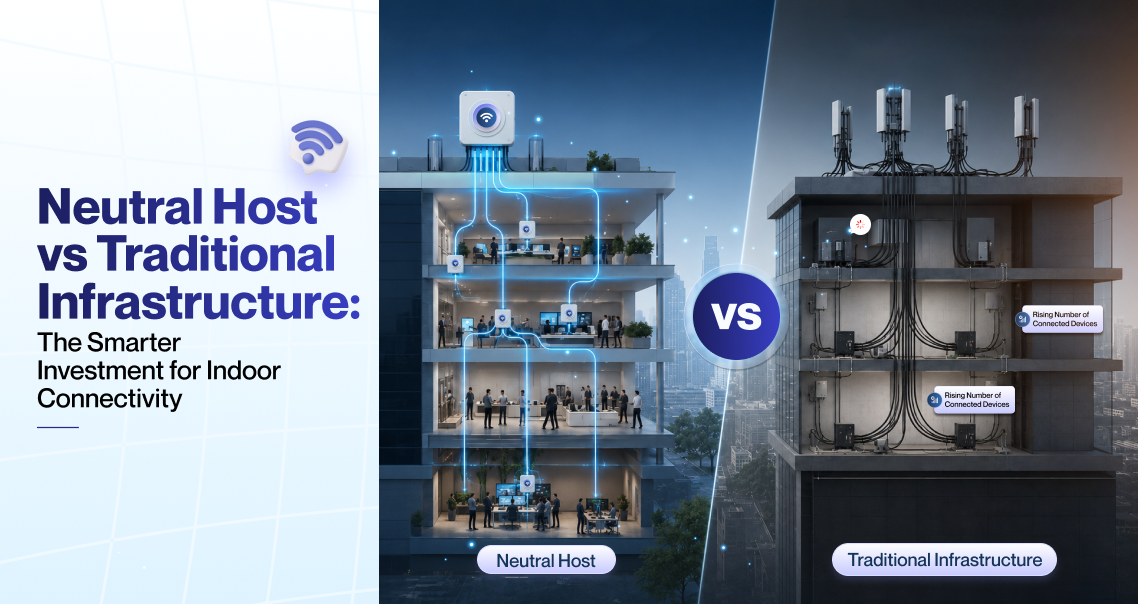
Neutral Host Infrastructure is a shared telecom model where several mobile network operators use one indoor network. Instead of each operator installing their own antennas, cables, and equipment, a Neutral Host Operator sets up and manages a single system that everyone can use. This removes duplicate infrastructure and gives reliable coverage to everyone in the building.
💠 How Does It Work?
A001+ Neutral Host setup uses a shared Distributed Antenna System (DAS) to spread mobile signals throughout the building. It also includes shared fiber, antennas, power, and network equipment, so multiple operators can offer their services on the same network. Because everyone uses the same system, buildings need less equipment but still get strong, reliable coverage.
💠 Understanding the Neutral Host Ecosystem
A successful Neutral Host setup involves several important groups, each with their own role:
- Building Owner: Provides the space for the shared telecom infrastructure while benefiting from simplified operations and enhanced property value.
- Neutral Host Operator: Designs, deploys, operates, and maintains the shared indoor wireless infrastructure, ensuring reliable performance and scalability.
- Mobile Network Operators: Deliver their mobile services via shared infrastructure rather than deploying separate networks.
- End Users: Employees, tenants, visitors, shoppers, patients, and other occupants enjoy uninterrupted mobile connectivity regardless of their network provider.
💠 Why Businesses Are Choosing Neutral Host Infrastructure?
Neutral Host Infrastructure has big advantages over traditional setups. By using one shared network instead of many separate ones, it saves space and keeps buildings less cluttered. Sharing the network also lowers installation and running costs by cutting out extra equipment and making maintenance easier.
A Neutral Host model also gives stronger, more reliable indoor coverage, so users get a better experience no matter which mobile operator they use. Its flexible design makes it easy to add more capacity or new tech like 5G and IoT without major upgrades. This means businesses, property owners, and operators get an efficient, cost-effective solution that’s ready for the future.
Neutral Host vs Traditional Infrastructure: Key Differences
Traditional Telecom Infrastructure and Neutral Host Infrastructure both provide reliable indoor mobile connectivity, but they are designed, deployed, and managed differently. Knowing these differences helps property owners, developers, and businesses pick the solution that best fits their long-term needs.
| Feature | Traditional Infrastructure | Neutral Host Infrastructure |
| Infrastructure Ownership | Each mobile operator owns and manages its own network. | A Neutral Host Operator owns and manages a shared infrastructure used by multiple operators. |
| Number of Networks | Multiple independent networks within the same building. | One shared network supporting multiple operators. |
| Deployment Cost | Higher due to separate installations by each operator. | Lower through shared infrastructure and reduced duplication. |
| Space Requirements | Requires more equipment rooms, antennas, and cabling. | Optimizes building space with a single infrastructure. |
| Maintenance | Each operator maintains its own equipment independently. | Centralized maintenance by the Neutral Host Operator. |
| Scalability | Expansion often requires additional infrastructure. | Easily scalable to support future capacity and technologies. |
| Time to Deploy | Longer due to multiple design and installation cycles. | Faster deployment through a unified implementation approach. |
| Future Readiness | Upgrades can be complex and disruptive. | Designed to accommodate future technologies with minimal disruption. |
| 5G Support | Each operator upgrades its network separately. | Shared infrastructure simplifies 5G deployment for all operators. |
| Multi-Operator Support | Requires multiple independent installations. | Supports multiple operators through a single shared network. |
| Tenant Experience | Coverage quality may vary depending on the operator. | Delivers consistent indoor connectivity across supported operators. |
| Building Aesthetics | Multiple antennas and equipment can create visual clutter. | Fewer visible components maintain a cleaner building environment. |
| Operational Efficiency | Higher operational complexity due to separate systems. | Streamlined operations with centralized management. |
| Sustainability | Increased energy consumption and equipment usage. | Reduces hardware, energy consumption, and environmental impact. |
Understanding the Difference:
Infrastructure Ownership and Network Design
In traditional infrastructure, each mobile operator owns and controls its own network, so several separate systems may be installed in a single building. A Neutral Host model, on the other hand, uses one shared network managed by a Neutral Host Operator. This setup reduces duplicate equipment but still provides good service to all operators.
Cost, Space, and Maintenance
In traditional setups, each operator installs its own antennas, cables, and equipment. This leads to higher costs, greater space requirements, and more complex maintenance for property owners. With Neutral Host Infrastructure, operators share one network, which lowers costs, makes maintenance easier, and uses building space more efficiently.
Scalability and Future Readiness
With the rise of 5G, IoT, and smart building technology, networks must be scalable. Traditional infrastructure often requires new equipment whenever capacity or technology changes. Neutral Host Infrastructure is built to scale easily, so upgrades and new technology can be added quickly without major changes.
Business and User Experience
For building owners and tenants, the differences are not just technical. Neutral Host systems provide consistent coverage from multiple operators, enhance the experience for tenants and visitors, and keep buildings clean by hiding most equipment. Centralized management also makes operations more efficient. By reducing excess hardware and energy use, Neutral Host solutions support sustainability and are a smart, long-term choice for modern buildings.
Why is a Neutral Host the Smarter Investment?
As connectivity becomes a crucial part of modern building infrastructure, property owners and enterprises are looking beyond short-term deployment costs. They require solutions that are scalable, cost-efficient, and capable of supporting future technologies. Neutral Host Infrastructure addresses these needs by replacing multiple independent networks with a centralized, shared platform that delivers long-term value for both building owners and mobile network operators.
➡️ Lower Capital Investment
Traditional telecom deployments need each MNO to install its own antennas, cabling, and network equipment, resulting in duplicated infrastructure and higher capital expenditure. Neutral-host infrastructure eliminates this redundancy by enabling multiple operators to share a common network. Instead of funding multiple parallel deployments, facility owners invest in a single, optimized infrastructure that decreases this redundancy by allowing several operators to share a common network. Instead of funding several parallel deployments, building owners invest in a single, streamlined infrastructure that decreases installation costs while maximizing resource utilization.
➡️ Decreased Operational Costs
Handling multiple independent telecom networks can be both expensive and time-consuming. Separate maintenance schedules, equipment upgrades, and technical support add to operational complexity throughout the building’s lifecycle. A neutral host model centralizes these responsibilities within a single shared infrastructure, streamlining maintenance and reducing ongoing operational expenses. Shared upgrades also enable operators to adopt new technologies without needing several independent modernization projects.
➡️ Better Tenant Experience
Trustworthy indoor connectivity has become a primary factor in tenant satisfaction. Employees depend on uninterrupted communication and cloud applications, shoppers expect seamless digital experiences, and visitors demand consistent mobile coverage throughout a facility. Neutral host infrastructure provides high-quality, uniform connectivity across multiple mobile operators, ensuring users experience fewer dropped calls, stronger signal quality, and faster data speeds regardless of the network service provider.
➡️ Faster 5G Deployment
As businesses adopt IoT, 5G, and smart building technologies, network infrastructure should be ready to support increasing connectivity demands. Neutral host infrastructure is developed with scalability in mind, enabling new technologies to be incorporated more efficiently than traditional operator-specific deployments. As several operators share the same foundation, 5G services can be introduced faster with minimal disruption to facility or building operations.
➡️ Increased Property Value
Connectivity at this point is considered a vital component of premium commercial real estate. Buildings that provide reliable indoor mobile coverage are more attractive to investors, tenants, and businesses seeking digitally enabled work environments. By investing in future-ready connectivity platforms, property owners can strengthen their competitive advantage, enhance occupancy rates, and improve the long-term value of their assets.
➡️ Sustainable Infrastructure
Sustainability is becoming a crucial consideration in building operations and development. Traditional telecom deployments typically require multiple sets of equipment, increasing energy consumption and material use. Neutral host infrastructure reduces the overall hardware footprint by consolidating networks onto a single, centralized shared platform. Fewer antennas, less cabling, and streamlined equipment not only reduce energy use but also minimize environmental impact, supporting more sustainable business operations.
Best Applications of Neutral Host Infrastructure
Neutral Host Infrastructure is particularly valuable in environments where large numbers of people, multiple mobile operators, and continuous connectivity are crucial. By offering a scalable, shared network, it ensures trustworthy indoor coverage while reducing infrastructure complexity and operational expenses.
▶️ Commercial Offices
Modern workplaces depend on cloud apps, mobile collaboration, and video conferencing. Neutral host infrastructure offers easy connectivity, improving employee productivity and supporting hybrid work environments.
▶️ Airports and Transportation Hubs
Airports, metro stations, and railway terminals experience high passenger traffic and constant usage. Shared infrastructure ensures uninterrupted connectivity for operational teams, travelers, and emergency services.
▶️ Hospitals
Hospitals or healthcare rely on dependable communication for patient care, emergency response, and connected mobile devices. Neutral host infrastructure supports vital operations with consistent indoor coverage across the complete healthcare facility.
▶️ Hotels and Shopping Malls
Guests and shoppers expect uninterrupted mobile connectivity for communication, navigation, digital payments, and entertainment. A neutral host network improves customer experiences while streamlining infrastructure management for property owners.
▶️ Universities and Stadiums
Huge campuses and event venues simultaneously accommodate thousands of users. Neutral host infrastructure efficiently handles high network demand, ensuring trustworthy connectivity during sporting events, lectures, concerts, and public gatherings.
▶️ Manufacturing Facilities
Smart factories largely depend on connected machinery, automation, real-time monitoring, and sensors. A shared scalable network supports operational efficiency while allowing digital transformation initiatives.
▶️ Mixed-Use Developments and Smart Cities
Mixed-use developments combine offices, residences, and hospitality within a single complex, needing easy connectivity across varied environments. Likewise, smart cities rely on integrated wireless infrastructure to support intelligent transport, connected utilities, public services, and IoT apps. Neutral host infrastructure provides a future-ready foundation to scale emerging connectivity demands while minimizing infrastructure duplication.
When Traditional Infrastructure Still Makes Sense?
Although Neutral Host infrastructure is the preferred choice for most modern commercial buildings, traditional telecom infrastructure can still be a perfect option in certain situations.
*️⃣ Small Buildings with Simple Connectivity Requirements
Standalone offices, residential buildings, or small commercial properties with lower user density may only need coverage from a single MNO. In these cases, deploying separate shared infrastructure may not be necessary.
*️⃣ Remote or Temporary Locations
Traditional infrastructure is also well suited for remote sites with limited connectivity needs, as well as for temporary environments such as construction sites, short-term events, or exhibition venues where long-term infrastructure investment is not practical.
*️⃣ Single-Operator Deployments
If a building primarily serves users of a single MNO, an operator-specific deployment can provide sufficient coverage while enabling the operator to retain full ownership and control of its network.
*️⃣ Planning for Future Growth
Even in these scenarios, connectivity needs can change over time. As facilities expand, occupancy increases, or new digital technologies such as IoT, 5G, and smart building systems are introduced, the need for scalable, multi-operator connectivity becomes more apparent. Planning for future expansion can make the transition to a neutral host infrastructure seamless.
How to Choose the Right Indoor Connectivity Model?
Choosing the right indoor connectivity model depends on your building’s current needs and the business’s long-term objectives. While traditional telecom infrastructure may be perfect for smaller projects, larger and future-focused developments mostly benefit from the scalability and flexibility of a neutral host model. Keep the following questions in mind before making your decision,
A quick decision checklist:
1️⃣ How many tenants or occupants will the facility accommodate?
Buildings with several tenants typically need consistent connectivity for users across MNOs.
2️⃣ Do you require support for multiple operators?
If easy coverage for subscribers of different operators is a priority, a shared neutral host infrastructure is mostly the more effective solution.
3️⃣ Are you planning for smart building technologies and 5G?
Future-ready facilities and buildings should be equipped fr supporting IoT devices, 5G, automation systems, and other connected technologies.
4️⃣ Will your connectivity requirements grow over time?
Pick infrastructure that scales easily without requiring major upgrades or additional installations.
5️⃣ What is the size and complexity of the facility or building?
Large commercial properties, airports, hospitals, and mixed-use developments generally benefit from shared, centralized infrastructure.
6️⃣ What are your budget and maintenance capabilities?
Consider not only the initial deployment expense but also long-term upgrades, maintenance, and operational efficiency when evaluating your options.
Why the Future Belongs to Neutral Host Infrastructure?
The future of indoor connectivity is being shaped by technologies that demand faster, more trustworthy, and highly scalable wireless networks. As businesses and cities become increasingly connected, neutral-host infrastructure is emerging as the foundation for supporting these evolving digital ecosystems.
🔶 Powering Next-Gen Technologies
The rapid adoption of private wireless networks, 5G, and the Internet of Things (IoT) is changing how businesses work. From connected manufacturing equipment and smart healthcare systems to real-time analytics and autonomous work, these technologies require uninterrupted, high-capacity indoor connectivity that traditional infrastructure often struggles to deliver efficiently.
🔶 Enabling Smart Buildings and Digital Workplaces
Modern commercial buildings are becoming intelligent environments equipped with AI-driven building management systems, energy monitoring, automated security, and connected workplace solutions. A future-ready infrastructure ensures these technologies work seamlessly while allowing businesses to scale as new innovations emerge.
🔶 Supporting Smarter Cities
As smart city initiatives continue to expand, trustworthy indoor and outdoor connectivity will play a crucial role in enabling connected public services, digital utilities, intelligent transportation, and citizen experiences. Neutra: host infrastructure provides a scalable platform that supports these emerging connectivity needs across varied environments.
🔶 The Shift Toward Carrier-Neutral Networks
Across the world, businesses are largely embracing carrier-neutral deployments that enable multiple mobile network operators to share a single infrastructure. This approach reduces infrastructure duplication, speeds up 5 G deployment, and provides a consistent user experience. As connectivity becomes a crucial business asset, neutral host infrastructure is no longer an alternative; it has become a global standard for building sustainable, future-ready, and digitally connected spaces.
Final Thoughts
As indoor connectivity needs continue to grow, selecting the right infrastructure is not just a technical decision; it is a strategic investment. While traditional cellular network infrastructure may still work in certain environments, neutral host infrastructure offers better scalability, multi-operator support, and readiness for emerging technologies such as IoT, 5G, and smart buildings. For enterprises and commercial properties seeking future-proof connectivity, a neutral host model delivers long-term value and superior user experiences.
NeutraCom helps businesses build trustworthy, carrier-neutral indoor wireless infrastructure that improves connectivity, simplifies operations, and prepares buildings for the digital future. Partner with NeutraCom to develop smarter and more connected spaces.
Frequently Asked Questions
Yes. The existing commercial buildings can be retrofitted with a neutral host infrastructure after a detailed site assessment. The process includes evaluating the building layout, existing telecom infrastructure, coverage gaps, and connectivity needs to design a solution that minimizes disruption while enhancing indoor mobile coverage and network performance.
No. A neutral host network complements MNO rather than replacing it. It provides a shared indoor infrastructure that enables multiple operators to deliver reliable coverage and capacity to subscribers without each operator having to deploy separate equipment. Within the same building.
Deployment timelines depend on several factors, including the size of the building, architectural complexity, coverage objectives, and integration needs. A detailed site survey and network design are typically conducted first to ensure the infrastructure is optimized for current and future connectivity needs.
Property developers should assess building size, occupancy levels, expected mobile traffic, construction materials, plans for future expansion, smart building initiatives, and the requirement for multi-operator connectivity. Planning indoor wireless infrastructure early in the project lifecycle can streamline deployment, decrease long-term costs, and enhance complete building performance.
Instead of coordinating with multiple operators individually, property owners work with a single neutral host operator that handles the shared infrastructure. This streamlines the deployment process, reduces maintenance costs, simplifies operations, and enables easy support for multiple operators.
Yes. Neutral-host infrastructure is designed to scale with evolving business needs. As new buildings, floors, or facilities are added, the existing infrastructure can be expanded without requiring separate network deployments for each mobile operator, making future growth more cost-effective and efficient.
Yes. Integrating indoor connectivity during the design and construction phases is generally more affordable than retrofitting after construction. Early planning enables infrastructure to be incorporated into the building’s design, decreasing installation complexity, minimizing future disruptions, and avoiding expensive modifications later.
Trustworthy indoor mobile connectivity has become a primary expectation for occupants and businesses. Buildings that offer easy coverage across multiple operators provide a better user experience, making them more attractive to prospective tenants, supporting higher occupancy rates, and strengthening the property’s long-term competitive value.