
Key Takeaways:
- Neutral host networks enable multiple mobile operators to share one indoor wireless infrastructure.
- Multi-operator DAS distributes cellular signals across complex, high-density buildings and challenging indoor environments.
- Shared infrastructure can reduce network duplication, deployment complexity, and infrastructure management requirements.
- RF planning, scalable architecture, and centralized monitoring help maintain reliable connectivity and support future 5G requirements.
- Choosing an experienced neutral host provider helps ensure scalable, compliant, and well-managed indoor connectivity infrastructure.
Overview – Why Multi-Operator Indoor Connectivity Matters
Indoor connectivity is crucial for buildings and public spaces. Yet, supporting users across several mobile networks can make indoor network coverage complex and infrastructure intensive.
Neutral host networks address this challenge by allowing multiple MNOs to share a common wireless infrastructure. Rather than deploying separate systems for each operator, a shared network can provide consistent connectivity within the same environment. This blog explores how neutral host networks support multi-operator connectivity across the same environment.
This article explores how neutral host networks support multi-operator connectivity, the technologies behind them, their advantages, and where they can deliver the greatest value.
What is a Neutral Host Network?
A Neutral host network is a shared wireless infrastructure that allows multiple mobile network operators(MNOs) to offer cellular connectivity via a common network. Instead of each operator deploying its own indoor infrastructure, a neutral host develops and manages shared infrastructure that can serve multiple operators.
The neutral host operator acts as the infrastructure partner between property owners and participating mobile network operators. It can oversee network design, deployment, monitoring, operation, and maintenance while enabling each operator to deliver services to its subscribers. This model is primarily valuable for complex infrastructure and high-density venues that require coverage from multiple operators.
A Neutral Host Operator can help create a shared connectivity layer that reduces infrastructure duplication while supporting trustworthy multi-operator coverage.
Neutral Host Vs. Traditional Infrastructure
| Traditional Operator Infrastructure | Neutral Host Network |
| Separate infrastructure for operators | Shared infrastructure |
| Multiple deployment needs | Common deployment |
| Operator –specific handling | Centralized infrastructure handling |
| Infrastructure duplication | Reduced duplication |
| Individual operator Coverage | Multi-operator coverage |
How Does a Neutral Host Network Enable Multiple Operators?
A neutral host network enables MNOs to share the same indoor wireless infrastructure. The process mainly involves 5 key stages.
🔷 Assess the Indoor Environment
The building is evaluated for layout, structure, user density, existing coverage, and RF conditions to determine coverage and capacity needs.
🔷 Designing Shared Infrastructure
Engineers design the network using DAS, fiber infrastructure, headend equipment, remote units, and antennas for supporting multiple operators.
🔷 Integrating Multiple Operators
Participating network operators connect their network resources to the shared infrastructure, enabling the signals to be distributed via the same indoor system.
🔷 Distributing Signals Throughout the Building
DAS, fiber networks, remote units, and antennas distribute operator signals across floors, corridors, basements, and other challenging indoor areas.
🔷 Monitoring and Optimizing Performance
The neutral host continuously monitors network performance and handles testing, maintenance, troubleshooting, and optimization to maintain trustworthy indoor connectivity.
How Does Neutral Host Networks for MNOs Work?
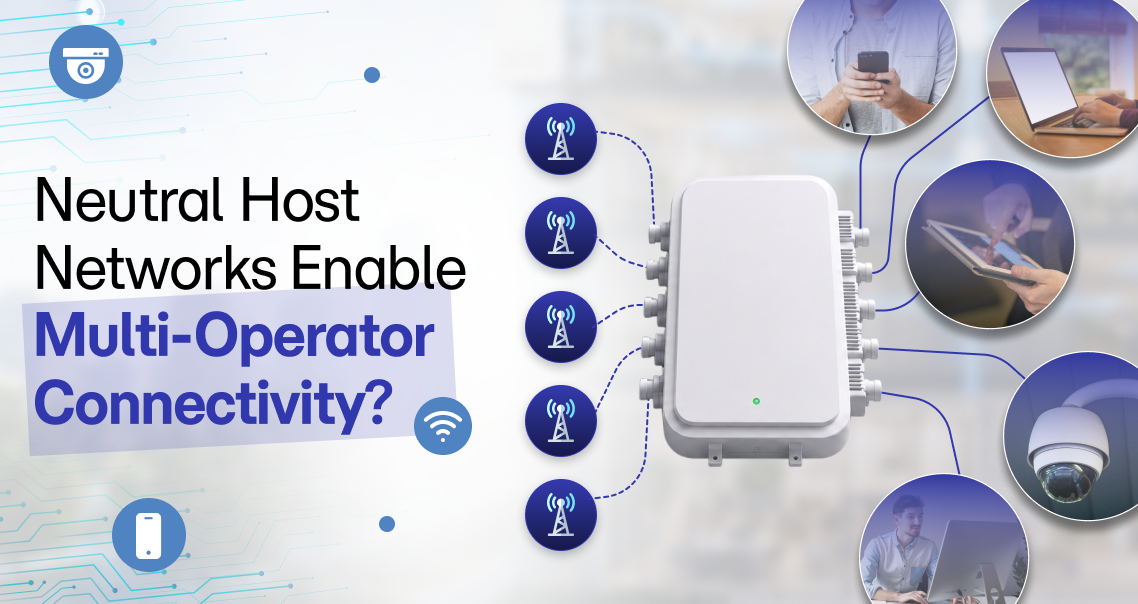
Multiple MNOs → Shared Neutral Host Infrastructure → DAS/Fiber Network → Distributed Antennas → Users
This shared approach reduces infrastructure duplication while allowing subscribers across participating networks to access trustworthy indoor connectivity via a common network.
Note: How long does it take to deploy a neutral host network?
Deployment timelines depend on the complexity of the building operator’s needs, infrastructure readiness, project scope, and regulatory approvals.
What Technologies Power Multi-Operator Neutral Host Networks?
A neutral host network relies on a combination of fiber, wireless, RF engineering, and shared monitoring technologies. Together, these components enable multiple operators to use a shared indoor connectivity infrastructure.
🔶 Active DAS
Active DAS uses digital equipment and fiber for distributing cellular signals across large or complex buildings.
- Supports multiple operations and frequency bands.
- Provides scalable indoor coverage nd capacity.
- Suits large venues and high-density environments.
🔶 Passive DAS
Passive DAS distributes RF signals via components such as splitters, coaxial cables, antennas, and couplers.
- Works well for suitable building layouts.
- Offers structured indoor signal distribution.
- Cannot support multiple operator deployments based on network needs.
🔶 Fiber Backbone
The fiber backbone connects central equipment with distributed network components throughout the building.
- Allows high-capacity signal transport.
- Supports long-distance indoor distribution.
- Offers a scalable base for growing connectivity needs.
🔶 Small Cells
Small cells provide localized cellular coverage and additional capacity in areas that need stronger, more targeted connectivity.
- Helps address coverage gaps.
- Adds capacity in high-traffic areas.
- Can complement DAS deployment where needed.
🔶 RF Planning & Optimization
An RF engineer determines how the network should be designed based on the building’s structure, coverage needs, and user density.
- Includes propagation modeling and coverage planning.
- Guides antenna placement and network design.
- Testing helps find and resolve performance issues.
🔶 Network Monitoring Systems
Centralized monitoring gives operators and infrastructure managers visibility into the shared network’s performance and operation status.
- Helps find faults and performance issues.
- Supports proactive maintenance.
- Allows ongoing network optimization.
Note: Can neutral host infrastructure support both 4G and 5G?
Yes. NeutraCom’s multi-operator DAS solution can support 2G, 3G, 4G, 5G, and connectivity in suitable indoor environments.
How Does Multi-Operator DAS Work?
A multi-operator Distributed Antenna System (DAS) enables multiple mobile network operators to deliver cellular services via the same indoor antenna infrastructure. It develops a shared connectivity layer while keeping each operator’s network services separate.
The process works as follows:
- Operator Signals Enter the DAS: Participating MNOs feed their approved cellular signals into a shared headend.
- Signals Are Transported: The DAS distributes these signals via fiber and other network components across the building.
- Remote Units Distribute Signals: Remote units extend the signals to different floors and areas.
- Antennas Provide Coverage: Strategically placed antennas transmit the signals to users throughout the facility.
- The Network is Monitored: Performance is tested and optimized for maintaining reliable coverage and capacity.
What Are the Advantages of Multi-Operator Connectivity?
Multi-operator connectivity enables several mobile network operators to utilize shared indoor infrastructure. This model can streamline deployment while enhancing connectivity for network operators, property owners, facility managers, and end users.
▶️ Benefits for Mobile Network Operators
- Lower Infrastructure Duplication: Share indoor infrastructure rather than deploying separate operator-specific systems.
- Faster Indoor Coverage: Extend reliable cellular coverage across challenging indoor environments more efficiently.
- Reduced Operational Complexity: Simplify deployment and management via shared neutral-host infrastructure.
- Scalable Network Expansion: Support additional operators, technologies, and capacity as requirements evolve.
▶️ Benefits for Property Owners and Developers
- One Shared Infrastructure: Offer multiple operators with connectivity via one coordinated indoor network.
- Better Tenant Experience: Provide reliable connectivity for employees, guests, and visitors.
- 5G-Ready Infrastructure: Prepare properties for changing cellular technologies and future connectivity needs.
▶️ Benefits for End Users
- More Consistent Coverage: Access preferred mobile networks across challenging indoor areas with fewer coverage gaps.
- Fewer Connectivity Gaps: Improve indoor coverage across basements, corridors, enclosed spaces, and other complex areas.
- Better Mobile Experience: Support reliable calling, applications, messaging, and mobile data services.
▶️ Benefits for Facility Managers
- Centralized Infrastructure Management: Monitor and manage shared connectivity via a coordinated infrastructure framework.
- Simplified Maintenance: Decrease the complexity associated with maintaining several separate indoor wireless systems.
- Easier Future Upgrades: Adapt shared infrastructure to changing technologies, coverage, and capacity needs.
Where Are Neutral Host Networks Most Useful?
Neutral host networks are especially valuable in large, complex, or high-density environments where reliable multi-operator connectivity is essential. NeutraCom identifies six primary market segments for shared indoor connectivity.
➡️ Real Estate & High-Rise Developments
Shared infrastructure ensures reliable indoor coverage for residential towers, commercial buildings, and mixed-use developments.
➡️ Hospitality & Tourism
Hotels, resorts, and entertainment complexes benefit from consistent connectivity throughout guest rooms and common areas.
➡️ Retail & Commercial
Malls, retail centers, and business campuses require high-capacity connectivity to support dense user environments.
➡️ Transportation & Mobility
Airports, metro stations, tunnels, and mobility hubs need reliable connectivity in challenging indoor environments.
➡️ Industrial & Logistics
Factories, warehouses, and supply-chain facilities use private LTE to enable connected operations and automation.
➡️ Healthcare & Education
Hospitals, medical cities, and universities require secure, uninterrupted connectivity throughout their facilities.
What Challenges Do Neutral Host Networks Need to Address?
While neutral host networks simplify multi-operator connectivity, their deployment presents technical, operational, and regulatory challenges. Addressing these requires careful planning and ongoing management.
⏯️ Complex RF Environments
Challenge: Building materials, layouts, and user density can complicate indoor RF propagation.
Solution: RF surveys, propagation modeling, and antenna optimization support reliable coverage planning.
⏯️ Multi-Operator Integration
Challenge: Operators may have different frequency bands, technical requirements, and network configurations.
Solution: Flexible shared architectures allow multiple operators to integrate according to their specific requirements.
⏯️ Capacity Management
Challenge: High-density venues can experience significant traffic demands across multiple operators simultaneously.
Solution: Scalable DAS architecture and capacity planning address changing traffic demands.
⏯️ Network Visibility
Challenge: Shared infrastructure can complicate performance monitoring across participating operators.
Solution: Centralized monitoring offers visibility into performance, faults, and service conditions.
⏯️ Regulatory Compliance
Challenge: Deployments must satisfy applicable spectrum, licensing, RF, and telecommunications requirements.
Solution: Regulatory planning and operator coordination ensure compliant network deployment.
⏯️ Service-Level Management
Challenge: Multiple stakeholders can complicate responsibilities around performance, maintenance, and service availability.
Solution: Clearly defined SLAs set measurable standards and responsibilities for all stakeholders.
⏯️ Future Scalability
Challenge: Adding operators, technologies, or capacity can become difficult without flexible infrastructure.
Solution: Multi-tenant architecture streamlines future expansion and operator onboarding.
How Do Neutral Host Networks Support 5G and Future Connectivity?
Neutral host networks provide a shared infrastructure foundation for 5G, helping multiple operators deliver high-capacity connectivity without duplicating indoor network infrastructure.
1️⃣ Supporting Higher 5G Capacity
- 5G increases demand for high-capacity indoor connectivity, particularly in crowded buildings and venues.
- Shared DAS and small-cell infrastructure can distribute 5G signals across high-density environments.
- Scalable architectures allow capacity to grow as usage increases.
2️⃣ Enabling Wider Indoor 5G Coverage
- Modern buildings can cause signal loss, making consistent indoor 5G coverage challenging.
- Neutral host infrastructure helps extend operator coverage across complex indoor spaces.
- RF planning and optimization help maintain reliable coverage across different building areas.
3️⃣ Simplifying 5G Deployment
- Deploying separate 5G infrastructure for every operator can increase complexity, cost, and equipment requirements.
- A shared infrastructure allows multiple operators to use the same indoor network.
- Centralized deployment can simplify infrastructure management and future network upgrades.
5️⃣ Supporting IoT and Smart Buildings
- Future buildings will connect more devices, sensors, and systems that depend on reliable wireless infrastructure.
- Neutral host networks provide scalable connectivity for IoT and smart-building applications.
- Shared infrastructure can support evolving connectivity requirements without repeated network deployments.
6️⃣ Preparing for Future Technologies
- A future-ready neutral host architecture can evolve alongside changing mobile technologies and connectivity demands.
- 5G-ready infrastructure can support future network expansion and emerging applications.
- Flexible infrastructure helps buildings remain connected as technology requirements continue to evolve.
How to Choose the Right Neutral Host Network Provider?
Selecting a neutral host provider involves more than assessing connectivity. The ideal partner offers multi-operator expertise, advanced RF engineering, scalable infrastructure, regulatory compliance, and comprehensive network management. NeutraCom integrates these strengths to deliver reliable indoor connectivity throughout Egypt.
❇️ Multi-Operator Expertise
NeutraCom provides shared infrastructure that allows multiple mobile operators to deliver indoor connectivity through a single network.
❇️ Strong RF Engineering
Capabilities include RF planning, propagation modeling, antenna design, testing, optimization, and iBwave-certified network design.
❇️ 5G-Ready Infrastructure
NeutraCom deploys scalable Active and Passive DAS, fiber backbones, and distributed infrastructure to meet evolving connectivity needs.
❇️ End-to-End Network Management
NeutraCom manages the entire infrastructure lifecycle, from design and deployment to monitoring, maintenance, and optimization.
❇️ Regulatory Expertise
NeutraCom operates under the NTRA Neutral Host Operator framework, meeting all relevant telecom, RF, public safety, and infrastructure requirements.
❇️ Scalability and Flexibility
The shared infrastructure model enables networks to add operators, technologies, coverage, and future capacity as needed.
❇️ Proven Telecom Experience
Supported by HitekNOFAL, NeutraCom draws on over 38 years of telecom and ICT integration experience.
Final Thoughts
Neutral host networks offer a practical way for delivering multi-operator connectivity via shared indoor infrastructure. By combining DAS, RF planning, fiber networks, monitoring, and scalable architecture, they help operators extend coverage while decreasing infrastructure duplication.
For property owners and users, the model helps ensure consistent connectivity across high-density, complex environments. As IoT, 5G, and smart-building apps keep on growing, flexible indoor infrastructure will become majorly important.
Picking an experienced neutral host partner can help ensure reliable performance, regulatory alignment, and future scalability. With its multi-operator capabilities, RF expertise, and end-to-end infrastructure management, NeutraCom supports businesses in developing, connecting, and future-ready indoor environments across Egypt.
Frequently Asked Questions
Yes, NeutraCom will assess the existing building and design suitable neutral-host infrastructure based on capacity, coverage, and structural needs.
Yes, NeutraCom designs scalable infrastructure that can accommodate additional technologies, operators, and capacity as the connectivity needs evolve.
NeutraCom utilizes centralized monitoring, network testing, optimization, and ongoing maintenance to ensure reliable indoor connectivity performance.
Property owners must evaluate building structure, coverage needs, user density, operator requirements, scalability, RF conditions, and infrastructure availability.
Yes, NeutraCom can design RF solutions for challenging areas, including basements, enclosed spaces, tunnels, and locations with weak outdoor signals.
Yes. NeutraCom’s scalable infrastructure can support smart-building applications, IoT, and evolving wireless connectivity needs.