
Key Takeaways:
- Multi-operator DAS delivers reliable indoor mobile coverage across shopping malls, retail floors, parking areas, and challenging building zones.
- Shared DAS infrastructure supports multiple mobile operators, keeping shoppers, employees and visitors connected across the property.
- Scalable DAS infrastructure helps retail spaces reduce connectivity gaps and control long-term infrastructure costs.
The Hidden Connectivity Challenge Inside Retail Spaces
Walk through a shopping mall and retail space, and you might notice a shopper unable to complete an online payment successfully, or phones losing signal near the parking lot.
This isn’t a coincidence because malls are built with materials that block cellular signals. Unlike a single office building that depends on one network, a retail space has to serve every carrier shoppers might be on. Additionally, during high foot traffic, Wi-Fi systems are stretched thin.
This is the exact problem that multi-operator Distributed Antenna Systems (DAS) solves.
Large malls and retail complexes account for an estimated 12-15% of DAS installations, largely due to their size, layouts, and coverage issues. DAS enhances connectivity for both guests and employees, delivering strong connections that lead to better customer experience and smoother everyday efficiency.
Why Do Shopping Malls and Retail Spaces Struggle with Indoor Mobile Connectivity?
Signal loss isn’t a random thing. Large spaces, dense construction materials, complex layouts, and underground levels can all affect how well mobile networks penetrate indoors.
Around 80-85% of mobile data traffic occurs indoors yet dedicated in-building wireless solutions cover less than 30% of commercial real estate.
➡️ Building Materials Can Block Signals
Cellular signals can weaken due to steel structures, concrete walls, and other dense materials, as they block signals from traveling through the building. This leaves some elevators, corridors, and enclosed areas with poor coverage.
➡️ Underground Parking Creates Coverage Gaps
Basement parking lots are surrounded by thick concrete and located at a distance from outdoor cell sites. Without indoor coverage infrastructure, shoppers and retailers may experience weak signals or lose connectivity altogether.
➡️ High Footfall Leads to Network Congestion
A shopping mall can have thousands of visitors using mobile data, accessing apps, scanning QR codes, making calls, or making digital payments. High user density can increase demand for available network capacity.
➡️ Different Users Use Separate Mobile Operators
Every shopper and retailer might not use the same network. That’s why a connectivity solution designed around only one operator fails to provide the same experience to everyone.
➡️ Emergency Systems Raise the Stakes
Weak indoor coverage is more than just a shopping inconvenience; it means first responders can’t communicate during an emergency. This creates compliance issues and compromises life safety.
What Makes DAS “Multi-Operator”?
A DAS becomes multi-operator when the same indoor wireless infrastructure supports mobile signals from multiple network operators.
Rather than building a separate indoor coverage system for each operator, a multi-operator DAS allows participating operators to share and deliver their signals across the property.
A single-carrier DAS serves one network. It’s a booster system for one provider. Properties installing single-carrier systems sometimes end up needing different infrastructure for additional networks, which eventually gets expensive.
How Does Multi-Operator DAS Work?
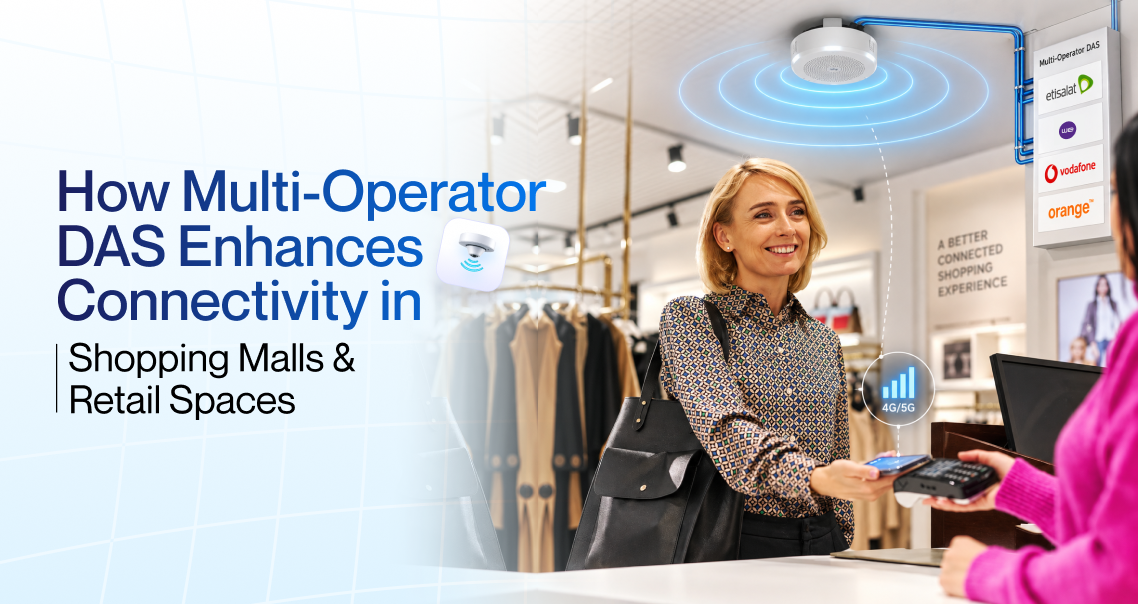
A multi-operator DAS brings signals from different mobile operators into a shared distribution system. The signals are thereafter transported through the DAS infrastructure and distributed to positioned indoor antennas.
In shopping malls, these antennas are placed strategically across space. This creates a shared indoor connectivity infrastructure that supports multiple operators in the same property.
This is best for large retail spaces, where consistent connectivity is part of delivering an exceptional indoor mobile experience.
Note: Who owns and maintains the DAS system after installation?
Ownership basically depends on the agreement between the owner and the DAS provider. At NeutraCom, we discuss this fully with our client and ensure transparency throughout the process. As the provider, we manage, monitor, maintain, troubleshoot, and optimize.
How Multi-Operator DAS Improves Shopping Mall & Retail Space Connectivity
Multi-operator DAS improves indoor connectivity in shopping malls and retail spaces by strengthening signal consistency, tenants, and keeping employees connected across coverage-challenging spaces.
Here’s how multi-operator DAS addresses the coverage gaps:
🔷 Extends Mobile Coverage Across the Property
- Antennas placed strategically distribute mobile signals across floors, common areas, and corridors.
- DAS maintains coverage where glass, concrete, steel, and large floor plans can weaken signals entering from outside.
🔷 Supports Multiple Mobile Operators
- Shoppers, employees, and tenants can stay connected through their preferred mobile network.
- Individuals are less likely to experience sudden signal loss as they move between different areas inside the property.
🔷 Supports 4G and 5G Connectivity
- DAS is capable of distributing 4G and 5G services across areas where reliable mobile access is important.
- A well-planned system provides an infrastructure base that adapts as mobile network requirements evolve.
🔷 Enhances Connectivity for Customers and Retailers
- Robust mobile connectivity allows shoppers to use apps, QR codes, loyalty programs, and more.
- Store teams and customers can rely on mobile services for everyday operational tasks and communication.
🔷 Regulatory and Life-Safety Compliance
- Multi-operator DAS supports Emergency Responder Radio Coverage Systems (ERRCS) essential in buildings with high foot traffic.
- Clearing inspections and ensuring compliance avoids penalties and insurance complications.
The overall effect is that connectivity stops being something shoppers constantly think about.
Key Benefits of Multi-Operator DAS for Shopping Malls & Retail Spaces
Coverage improvements are just half the story. Once multi-operator DAS is in place, the result shows up in the following way:
❇️ Enriched Customer Experience
Shoppers stay connected throughout, whether they are browsing, making payments, using apps, or just conversing over the phone inside the mall.
❇️ Higher Tenant Satisfaction
Retailers get strong connectivity indoors for staff communication, customer interactions, inventory tools, and everyday store operations.
❇️ Fewer Connectivity Complaints
Unlike earlier systems, a shared DAS infrastructure accommodates multiple mobile operators, giving shoppers and tenants exceptional coverage no matter their preferred network.
❇️ Future-Ready Connectivity
A multi-operator DAS gives shopping malls and retail spaces an adaptable connectivity foundation as mobile technologies, shopper expectations, and network requirements evolve.
❇️ Increased Revenue
Mobile wallets and location-based offers depend on real-time connectivity, and failed transactions mean lost sales. Retail spaces with reliable indoor coverage allow shoppers to stay longer.
❇️ Lower Long-Term Infrastructure Cost
One shared neutral host system removes the need for separate single-carrier boosters and maintenance costs. As new carriers enter, they connect seamlessly into existing infrastructure rather than requiring a brand-new build.
Note: Can a multi-operator DAS cover newly added floors or retail spaces later?
Yes, a scalable DAS can be expanded with antennas and distribution components to cover new floors of the retail area. This depends on a new RF assessment to determine the capacity needs and additional coverage.
Use Areas: Where Can Multi-Operator DAS Be Used in Retail Space
Multi-operator DAS is used across retail spaces where building materials or structures block mobile signals, from stores and food courts to parking spaces.
*️⃣ Common Areas and Corridors
Atriums or walkways experience the heaviest footfall and need consistent coverage. Getting these zones right means the rest of the property is easier to cover.
*️⃣ Anchor and Interior Stores
Stores deep inside sit farther from outdoor signals, creating dead zones. Weak coverage can disrupt retail operations and make it harder for shoppers.
*️⃣ Food Courts and Dining Areas
Dense seating and mobile ordering create congestion hotspots. DAS keeps QR menus, app pickups, and payments.
*️⃣ Parking and Garages
Steel and concrete make garages some of the worst dead zones in the building. Coverage supports security systems and emergency call boxes.
*️⃣ Elevators, Stairwells, and Basement Levels
Enclosed spaces lose signal fastest and need infrastructure to recover. Coverage is essential for ERRCS compliance, where first responders need working radios most.
*️⃣ Back-of-House and Service Corridors
Loading docks and staff areas need connectivity for inventory and coordination processes. It is easy to overlook planning, but it is costly to skip in operations.
*️⃣ Entertainment & Leisure Zones
Multi-operator DAS supports mobile connectivity across gaming areas, event spaces, and theatres within mixed-use properties.
How Is a DAS System Implemented?
Deploying a multi-operator DAS needs careful planning around the building, analyzing coverage gaps, and network demand. The process includes:
🔶 Step 1: Site Assessment
- Spot existing coverage gaps and challenges
- Examine building structure, coverage, and usage requirements
🔶 Step 2: RF Planning & Design
- Analyze signal needs across every zone
- Plan placement of antennas and capacity
🔶 Step 3: Operator Integration
- Coordinate requirements across network operators
- Integrate operator signals into shared infrastructure
🔶 Step 4: Infrastructure Deployment
- Install DAS equipment across locations that are planned
- Connect antennas, fiber, and supporting components
🔶 Step 5: Testing & Optimization
- Test signal strength across coverage areas
- Fine-tune system performance to eliminate gaps
🔶 Step 6: Ongoing Monitoring and Management
- Constantly monitor coverage and network performance
- Adjust infrastructure as connectivity needs change
Note: Do all carriers need to agree before a multi-operator DAS can be installed?
No, but each participating carrier needs to approve the technical and integration needs before connecting their network to the DAS. Team NeutraCom, coordinates carrier participation and agreements during the design phase itself.
What to Look for When Choosing a DAS Provider for Retail Spaces
Selecting the right DAS provider for a retail space or shopping mall involves more than just looking at the service cost. The right provider must have experience with multi-operator DAS installation, retail ecosystem, regulatory compliance, and ongoing system management.
Sure, not every DAS provider will build in the same way, and the choice affects how well the system performs years from now.
▶️ Neutral Host Experience
A provider should deploy neutral host systems before and no single-carrier boosters. The way one manages agreements across multiple carriers takes a different skillset altogether rather than serving one network.
▶️ Proven Track Record in Retail
Malls operate differently from office buildings because of footfall, peak-hour rushes, and complex layouts—all of which demand different design decisions. A provider with retail-specific experience works on these challenges instead of learning after undertaking the project.
▶️ Compliance and Life-Safety Expertise
Public safety communication isn’t optional, and getting it wrong may lead to inspection delays or occupancy troubles. The right provider builds compliance into the design right from day one.
▶️ Scalability for Future Needs
IoT devices, new carriers, 5G upgrades—the system installed today must be able to absorb these changes without the need for a complete rebuild. Ask the partner how their infrastructure handles future scaling.
▶️ Ongoing Support & Maintenance
Installation is just the beginning phase; a reliable provider will offer ongoing monitoring and maintenance services, fixing performance issues before tenants or shoppers notice.
Note: Can an existing DAS system be upgraded to support multiple operators?
Yes, in many cases. NeutraCom experts assess your current infrastructure first to see what can be retained and what needs to be replaced. It mostly depends on the existing system’s architecture, frequency support, capacity, equipment, and compatibility with operators.
Strengthen Shopping Mall and Retail Space Connectivity with NeutraCom
Indoor connectivity is a must-have today, same as fire suppression or HVAC. This is because retailers, customers, and first responders all depend on it every time and everywhere in the building.
That’s what NeutraCom does. As Egypt’s leading neutral host DAS operator, we deploy a multi-operator system built for retail spaces that deals with major carriers and compliance requirements at once.
Over the years, we have seen what weak indoor coverage costs a property, such as lost tenant confidence, compliance issues, or abandoned mobile transactions at the worst possible time.
Additionally, we have experienced what changes when it’s fixed: every carrier performs equally, with uniform coverage and infrastructure that scales as demand grows.
From retail floors to underground parking areas, NeutraCom helps shopping malls build a connected environment.