
Key Takeaways:
- Neutral host networks allow shared infrastructure, enabling multiple MNOs to deliver indoor connectivity without duplicating physical network assets.
- Shared DAS reduces deployment complexity and infrastructure duplication, helping MNOs manage indoor network investments more efficiently.
- Professional RF planning and optimization enhance indoor coverage across challenging environments like airports, malls, rise-buildings and healthcare facilities.
- Scalable fiber and DAS architectures support evolving 5G needs, helping MNOs accommodate future capacity and connectivity demands.
- The right neutral host partner provides a combination of technology, monitoring, operations and maintenance, and regulatory expertise for supporting reliable multi-operator indoor connectivity across Egypt.
Rising Demand for Reliable Indoor Connectivity
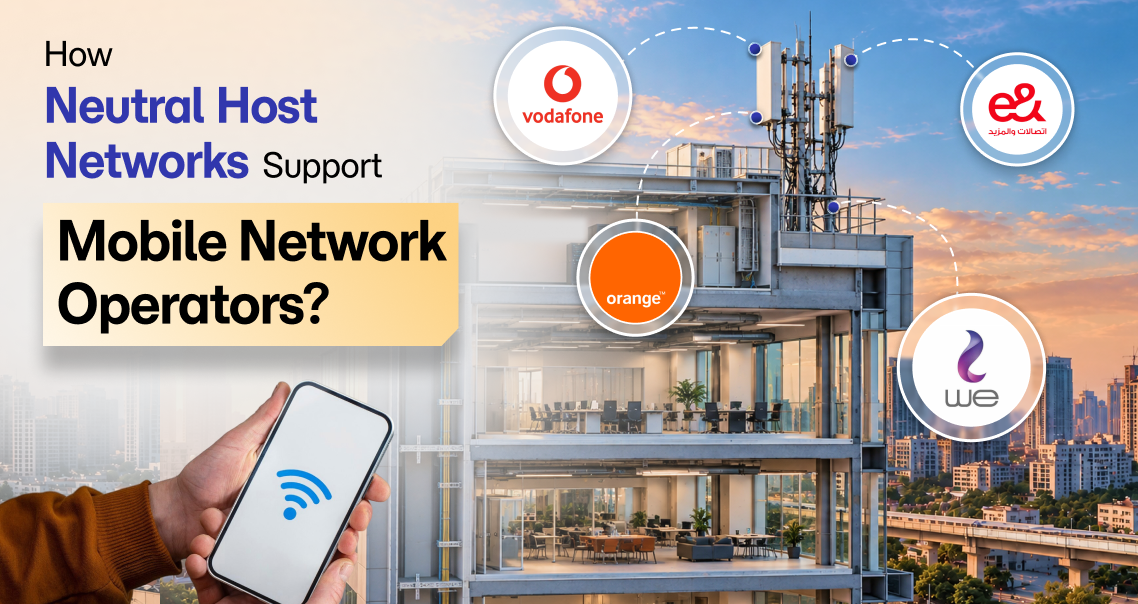
Reliable indoor coverage is now critical for mobile network operators, as users increasingly access mobile services in malls, offices, hotels, hospitals, and other high-traffic indoor spaces. Yet indoor connectivity can be difficult to deliver because of complex building layouts, growing data demand, signal-blocking materials, deployment costs, and coordination barriers. In Egypt, the NTRA has cited weak indoor coverage, high infrastructure costs, and coordination challenges between mobile operators and property developers as major reasons for introducing a neutral-host framework. Neutral host networks help address these issues by providing shared indoor wireless infrastructure that serves multiple operators, enabling MNOs to improve coverage while limiting duplicate infrastructure and operational complexity.
Why Neutral Host Networks Matter to MNOs?
With indoor traffic, 5G capacity needs, and deployment pressures increasing, neutral host networks offer MNOs a practical shared model for expanding reliable connectivity.
- Higher Indoor Connectivity Demand: As more users depend on mobile services inside buildings, MNOs face greater pressure to deliver consistent coverage in dense venues and high-traffic spaces.
- Greater Network Densification Needs: The growth of 5G and rising data usage call for denser infrastructure, making efficient deployment approaches essential for MNOs managing capacity.
- Less Duplicate Infrastructure: By sharing indoor systems, multiple operators can avoid separately installing overlapping equipment and cabling in the same locations.
- Simpler Multi-Operator Rollout: Neutral host networks optimize infrastructure coordination across operators, helping decrease complexities associated with site access, installation, maintenance, and building stakeholder management.
- Scalable Indoor Network Expansion: A shared, carrier-grade infrastructure model can help MNOs expand indoor coverage while supporting evolving technologies, capacity needs, and future connectivity needs.
Key Benefits of Neutral Host Networks for Mobile Network Operators
Neutral host networks help MNOs expand indoor connectivity through shared infrastructure, supporting cost efficiency, trustworthy coverage, faster deployment, operational simplicity, scalability, and improved utilization of network resources.
🔷 Lower Infrastructure CAPEX and OPEX
Sharing DAS, fiber, cabling, antennas, and supporting infrastructure reduces duplication, allowing MNOs to share investments and lower maintenance and operational costs.
- Shared DAS and antenna infrastructure
- Reduced equipment and installation duplication
- Distributed infrastructure and maintenance costs
🔷 Faster Indoor Coverage Expansion
A coordinated neutral-host deployment gives MNOs access to established indoor infrastructure, speeding coverage expansion in complex buildings, venues, and high-density locations.
- Coordinated site deployment
- Faster access to challenging indoor environments
- Consistent infrastructure across multiple locations
🔷 Improved Indoor Coverage and Capacity
Professionally engineered DAS distributes mobile signals throughout challenging indoor spaces, helping MNOs address coverage gaps and meet capacity needs in high-rise buildings, malls, airports, hotels, and other venues.
- Better signal distribution across buildings
- Coverage for high-density environments
- Support for indoor capacity requirements
🔷 Simplified Multi-Operator Deployment
Neutral-host infrastructure offers a coordinated physical network layer for participating operators, reducing the need for separate equipment, cabling, site access, installation coordination, and maintenance.
- Single shared infrastructure framework
- Simplified building coordination
- Reduced deployment-related complexity
🔷 Scalable 4G and 5G Infrastructure
Multi-band and fiber-based neutral-host architectures accommodate evolving operator requirements, providing a scalable infrastructure foundation as technologies, traffic patterns, and indoor capacity demands change.
- Multi-band infrastructure
- Fiber-based distribution
- Support for evolving 4G and 5G requirements
🔷 Centralized Infrastructure Monitoring
Centralized monitoring and network management provide greater visibility into shared indoor infrastructure, supporting fault detection, performance tracking, preventive maintenance, and continuous RF optimization for participating operators.
- NOC-based infrastructure monitoring
- Performance and fault visibility
- Ongoing RF testing and optimization
🔷 Better Network Resource Utilization
By sharing physical infrastructure, MNOs avoid unnecessary asset duplication and allocate network resources more strategically, supporting efficient indoor expansion while managing infrastructure across multiple operator environments.
- Reduced physical asset duplication
- More efficient infrastructure utilization
- Strategic allocation of network investment
🔷 Better Infrastructure Utilization
Sharing physical infrastructure lets operators use common sites, antennas, transmission systems, and other network components instead of duplicating assets within the same building or venue.
- Higher utilization of shared assets
- Less unnecessary infrastructure duplication
- More efficient network expansion
🔷 Greater Focus on Core Network Operations
With the neutral host responsible for designing, deploying, operating, and maintaining shared indoor infrastructure, MNOs can reduce the operational burden associated with venue-specific infrastructure management.
- Reduced infrastructure management workload
- Centralized monitoring and maintenance
- Greater focus on subscriber services
For Egypt, this model also aligns with the NTRA framework, which identifies high indoor network costs and coordination challenges between mobile operators and property developers as key considerations for shared indoor infrastructure.
How Neutral Host Networks Support 5G Expansion?
Neutral host networks can support 5G expansion by offering shared indoor infrastructure that helps mobile network operators MNOs deliver higher capacity, address indoor coverage challenges, and scale connectivity without deploying separate systems for every operator.
➡️ Higher Capacity Needs
5G increases expectations for capacity, speed, and network performance, particularly in high-density locations such as airports, shopping malls, hospitals, offices, and stadiums. Indoor networks should therefore place sufficient capacity where mobile traffic is concentrated.
➡️ Network Densification
As 5G networks evolve, operators require strategically distributed infrastructure to offer capacity where demand is highest. Neutral host deployments can help MNOs extend indoor coverage without independently building overlapping infrastructure.
➡️ Shared Infrastructure
A neutral host network enables multiple communications service providers to share a common indoor connectivity layer while maintaining their respective network services.
➡️ Future-Ready Architecture
Fiber backbones, active DAS, distributed radio nodes, and centralized monitoring can provide a scalable foundation for evolving indoor connectivity needs. This enables infrastructure to adapt as 5G technologies, capacity needs, and operator needs develop.
Where Can MNOs Use Neutral Host Networks?
MNOs can deploy neutral host networks in high-density environments where shared infrastructure enhances indoor coverage, capacity, operational efficiency, and multi-operator performance across venues and buildings.
| Environment | MNO Relevance |
|---|---|
| High-rise & mixed-use buildings | Shared indoor infrastructure helps the MNO overcome the vertical propagation challenges and offer consistent coverage across multiple floors, tenants, and complex buildings spaces. |
| Shopping Malls | Shared infrastructure helps MNOs handle high user density and capacity requirements while support reliable connectivity for shoppers, retailers, employees, and digital services. |
| Airports | Neutral host systems help MNOs support large footprints, high passenger volumes as well as demanding connectivity requirements across terminals, transit areas, and operational spaces. |
| Hotels & reports | Multi-operator indoor infrastructure helps MNOs extend coverage across guest rooms, multiple floors, common areas, and hospitality facilities without duplicating separate systems. |
| Stadiums & Venues | Neutral host infrastructure helps MNOs accommodate temporary traffic peaks and extremely high user density during events while maintaining scalable indoor network capacity. |
| Healthcare | Neutral host networks help MNOs provide trustworthy indoor communications across complex healthcare facilities supporting staff coordination, connected systems, and crucial operational areas. |
| Transportation Hubs | Shared indoor infrastructure helps MNOs offer coverage across enclosed, underground, and high traffic environments where trustable connectivity is necessary for passengers and operations. |
Note: What factors determine whether a building is suitable for neutral host deployment?
NeutraCom assesses building size, occupancy, signal conditions, traffic needs, existing infrastructure, and operator needs to determine neutral-host deployment suitability.
What Should MNOs Consider When Evaluating a Neutral Host Partner?
MNOs should evaluate neutral host partners based on multi-operator capabilities, RF expertise, scalability, operational support, and regulatory compliance.
1️⃣ Multi-Operator Capability
Choose infrastructure that supports multiple MNOs, technologies, and frequency bands while enabling efficient integration without compromising network performance.
2️⃣ RF Engineering Expertise
Assess expertise in RF planning, modeling, testing, and optimization to deliver trustworthy coverage across complicated indoor environments.
3️⃣ Scalable Architecture
Look for scalable DAS and fiber infrastructure that can support additional operators, higher capacity, and evolving 4G/5G needs.
4️⃣ Monitoring and O&M
Prioritize centralized monitoring, fault detection, maintenance, and performance management to maintain reliable shared indoor infrastructure after deployment.
5️⃣ Regulatory and Compliance Capability
Ensure the provider understands applicable telecom regulations and licensing requirements governing neutral host infrastructure deployment and operation in Egypt.
Note: What information is required from an MNO before indoor network design begins?
Before the indoor network design begins, NeutraCom typically needs building plans, coverage targets, frequency bands, traffic expectations, existing infrastructure details, and specific MNO integration needs.
Why NeutraCom for Mobile Network Operators?
NeutraCom provides shared, scalable indoor wireless infrastructure across Egypt, helping MNOs simplify deployment, strengthen coverage, and prepare networks for evolving connectivity needs.
🔶 Licensed Neutral Host Operator
NeutraCom works within Egypt’s regulated neutral-host ecosystem, offering compliant infrastructure solutions designed to support multi-operator indoor connectivity needs.
🔶 Multi-Operators DAS
NeutraCom’s multi-operator DAS enables multiple MNOs to offer cellular services via shared indoor infrastructure without duplicating physical network assets.
🔶 Carrier-Grade Technology
Active and passive DAS, a fiber backbone, distributed antenna nodes, a centralized headend, and NOC monitoring support trustworthy, professionally managed indoor connectivity.
🔶 End-to-End Lifecycle
NeutraCom manages the complete lifecycle from assessment, RF planning and design to deployment, integration, monitoring, optimization, and maintenance.
🔶 Future-Ready Connectivity
Scalable infrastructure supports evolving 4G and 5G requirements, helping MNOs adapt indoor capacity and coverage as connectivity demands continue to rise.
Conclusion
Indoor connectivity is becoming an increasingly important consideration for mobile network operators as users expect reliable mobile services across offices, malls, airports, hotels, healthcare facilities, and other complex buildings. Traditional operator-specific deployments can create infrastructure duplication, higher investment needs, and greater coordination complexity.
Neutral host networks provide an alternative by offering shared indoor infrastructure that multiple MNOs can use to deliver cellular connectivity. For operators, this model can support more efficient infrastructure investment, faster coverage expansion, improved indoor performance, simplified deployment, and continuous infrastructure management.
Scalable architectures can also accommodate evolving capacity needs and 4G/5G networks. As indoor connectivity needs keep on growing, neutral host infrastructure can offer MNOs a practical approach to expanding trustworthy coverage across Egypt.
Frequently Asked Questions
Yes, scalable neutral host architectures can accommodate additional MNOs through available capacity, compatible equipment, and planned infrastructure expansion as needed.
Deployment timelines vary depending on the size of the building, design complexity, RF needs, approvals, equipment availability, and integration needs across participating operators.
Yes, MNOs retain their branding, subscriber relationships, and service experience while using shared neutral host infrastructure for indoor network connectivity.
Performance is measured using coverage, signal quality, capacity, throughput, availability, interference levels, and operator-specific service performance across defined indoor areas.
The neutral host infrastructure can be assessed and optimized with capacity upgrades, additional nodes, or configuration changes to support increased traffic.
Yes, integration may be possible after a technical assessment of existing equipment, compatibility, RF design, infrastructure condition, and operator needs.