
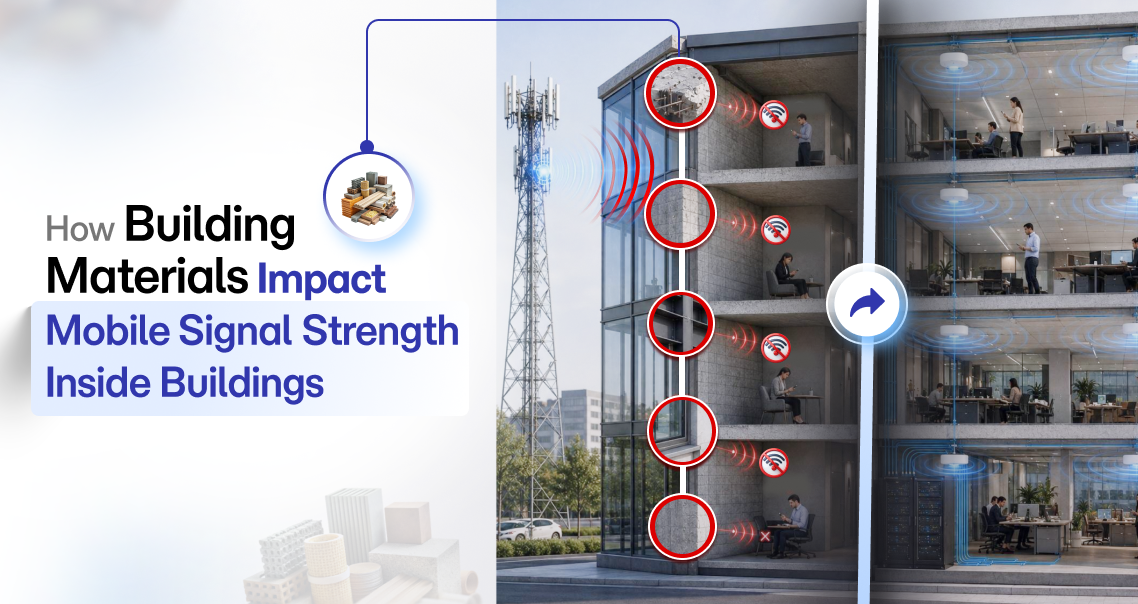
Key Takeaways:
- Building materials such as steel, concrete, and Low E-glass can weaken mobile signals.
- Signal behavior changes as radio frequencies encounter building materials that absorb, reflect, scatter, and diffract.
- DAS, neutral host systems, and more can improve mobile coverage based on building’s specific requirements.
- Professional coverage assessment helps spot signal issues and determine the right solution for reliable indoor cellular connectivity.
Why Your Building Materials Matter for Mobile Connectivity
Modern buildings are nothing short of marvels of engineering, designed to be structurally sound and highly energy efficient. However, the elements that make these buildings safe and environmentally friendly are the ones that give rise to hidden problems.
The elements used in modern buildings serve as invisible shields, absorbing or scattering radio frequencies before they enter the premises. This leads to dead zones where mobile and cellular signals drop, and two-way radios stop working.
Building occupants often complain about dropped calls and the disruptions caused. Especially for first responders, losing radio contact inside the modern structure can be catastrophic.
Reliable in-building mobile and cellular connectivity isn’t just about convenience, but in critical situations, it is highly crucial for coordinated response.
How Mobile Signals Travel Through a Building
Mobile signals do travel through air as radio frequency waves, and at the same time, they pass through what stands between the cell tower and your phone. This means, every wall, floor slab, and window a signal crosses cause it to lose its strength.
Some signal energy can pass through certain materials, while some are absorbed, reflected, or scattered.
For instance, signal coming from outdoor cell sites first has to pass through the building’s exterior wall or glass. Once inside, it may encounter concrete walls, partitions, ceilings, and other barriers inside. Each of these affects the signal’s strength and quality.
➡️ Absorption
- Dense materials absorb radio frequency energy as signals pass
- Concrete walls can weaken signals inside buildings
➡️ Reflection
- Metal surfaces reflect radio signals instead of penetrating them
- Steel structures create weak coverage across certain areas
➡️ Scattering
- Signals hit rough surfaces and split apart
- Metal roofs and steel beams trap signals outside and cause messy interference
➡️ Diffraction
- Signals bend around sharp edges and corners
- Waves squeeze through small openings like wall corners, pillars, and roof edges
Now you know that the signal strength inside a modern building depends on what comes between the outdoor network and the user. The thickness, type, and combination of building materials decide how much of that signal actually makes it indoors.
How Different Building Materials Affect Mobile Signal Strength?
A reliable, strong mobile signal has become essential in every aspect of modern life. Whether you are home, at work, or shopping, a high-quality mobile signal makes all the difference. However, many building materials can cause poor indoor connectivity.
🔷 Reinforced Concrete
Commonly used in modern buildings, known for its durability and strength. However, its density and internal steel reinforcement can make it tough for radio signals to penetrate.
🔷 Steel
Steel is a major challenge for indoor connectivity. Steel is widely used in columns, roofing, structural frames, and other building elements. However, its ability to reflect radio frequencies can affect signal distribution inside the structure.
🔷 Low-E Glass
Low-E glass has a thin metallic coating that reflects heat, keeping buildings cooler in summer and warmer in winter. The issue is that the same coating reflects radio frequencies too. Many times, it can cut signal strength by more than 90%, making it one of the biggest contributors to indoor dead zones.
🔷 Brick and Stone
Older buildings built with brick and stone experience moderate signal loss. Signal loss depends on wall thickness and the type of mortar used, but it’s not as extreme as the newer material combinations found in modern constructions.
🔷 Drywall and Wood
Generally, drywall and wood allow some radio signals to pass through compared to dense concrete or metal. However, their effect can depend on thickness, construction, and the number of layers.
🔷 Metal Roofing and Cladding
Metal roofing and cladding reduces indoor mobile and cellular connectivity strength because conducive metals bounce back and absorb radio frequency waves.
What Actually Fixes Poor Indoor Mobile Coverage in Buildings?
Today, more than 80% of emergency calls are received from mobile devices, yet indoor connectivity remains one of the most common challenges.
Indoor connectivity hurdles cannot be resolved on their own, and sure, waiting can have consequences.
So, we are listing solutions to bring usable cellular coverage into areas where buildings create barriers.
🔶 Distributed Antenna Systems (DAS)
A DAS uses a network of antennas that are placed strategically throughout the building to distribute signals across different areas. This makes it useful for large buildings where a signal from outside cannot reach every floor or room.
🔶 Neutral Host Systems
A neutral host system allows various mobile network operators to use shared in-building infrastructure. This is useful in buildings where visitors and occupants use different mobile networks.
🔶 Small Cells
Small cells fix poor indoor mobile coverage that acts as a dedicated cellular base station in a building. They work best where targeted coverage is needed or where existing outdoor signals can’t reach an indoor location.
🔶 Signal Boosters
Signal boosters, or signal repeaters, are a simple, cost-effective fix. They are ideal for small spaces or single-carrier issues, like one office floor with weak coverage from a single network. It improves indoor coverage by having an outdoor antenna to capture the existing signal and boost it indoors, giving people stronger connectivity inside the building.
Choosing the Right In-Building Solutions
There’s absolutely no single solution that works for every building. But the right approach depends on various factors, including the building’s size, materials, layout, existing signal conditions, and the number of users. With a professional survey, you can determine what kind of solution the building requires for reliable coverage throughout the space.
Which Buildings Need In-Building Mobile Coverage Solutions?
Poor mobile and cellular connectivity can happen in any building, but some are more likely to have signal problems due to various factors mentioned above. In these buildings, the outdoor mobile signal may not be strong enough to provide good coverage throughout.
▶️ High-Rise Buildings
Signal weakens with each floor, so upper levels often have worse coverage than the ground floor.
▶️ Hospitals
Hospitals face different kinds of stakes. Dead zones can delay staff communication and interfere with connected patient monitoring systems.
▶️ Shopping
With large floors and high footfall, consistent coverage can be difficult. Single antennas can’t reach every corner, especially across multiple levels.
▶️ Hotels
Guests expect reliable connectivity throughout the property, including parking spaces.
▶️ Airports
Airports combine metal-heavy constructions and thousands of people relying on connectivity at once. This makes them one of the hardest environments to cover properly.
▶️ Industrial Facilities
Steel structures, metal roofs, machinery, and large open spaces can interfere with signal distribution across the facility.
▶️ Stadiums
Large seating areas, steel elements, and thousands of users create significant demand for mobile connectivity.
▶️ Metro, Tunnels & Transportation Hubs
Underground tracks, tunnels, enclosed spaces, and concrete structures can prevent outdoor cellular signals from reaching passengers and operational areas.
How a Professional In-Building Coverage Assessment Works
A proper fix to poor indoor connectivity starts by knowing exactly why and where the signal is failing. A professional analysis helps by having experts inspect the building, assess existing network conditions, and identify areas where users experience poor connectivity.
- Assess the Building Structure: The initial step is to understand the size, layout, current signal condition, and construction material of the building to determine the next steps.
- Measure Existing Signal Strength: Engineers measure cellular signal strength across different areas of the building to understand how the existing network performs.
- Identify Coverage Gaps: The assessment accounts for weak-signal areas, dead zones, and spaces where data, calls, or radio communication drops or becomes unreliable.
- Analyze the Cause: Professionals then evaluate glass, steel, concrete, building layout, interference, and other factors that can cause poor indoor coverage.
- Design the Right Solution: Based on the analysis, the required solution can be planned, whether that involves DAS, small cells, neutral host system, or a combination of technologies.
- Test and Validate the Coverage: After deployment, coverage is tested across the important areas to confirm that the system is delivering consistent indoor connectivity.
The Role of NeutraCom in Improving In-Building Mobile Coverage
Building materials aren’t going to stop getting energy-efficient, and coverage issues aren’t going to fix themselves.
This is where NeutraCom comes in.
NeutraCom is Egypt’s leading neutral host operator, enabling seamless indoor mobile and cellular connectivity.
We start every project the same way, with proper site assessment, and from there, we recommend what the building actually needs. The goal is simple: to make sure building occupants can stay connected in areas where outdoor cellular networks struggle to reach.
Understanding the factors involved is the first step toward solving them. With a proper in-building coverage assessment and a solution designed around the structure, buildings can reduce coverage gaps and provide reliable connectivity throughout the premises.
Frequently Asked Questions
Yes, and this is one of the most common misconceptions we come across. In most cases, you don’t need to expand walls or redesign the floor plan to improve indoor coverage. Solutions such as DAS, small cells, and signal boosters can be integrated into the existing building infrastructure and designed around its current layout and construction. The right approach depends on the building, the existing signal conditions, and the areas that need better coverage.
Definitely, and it’s more common than fitting new construction. Most buildings we assess are already standing, office towers, hotels, and hospitals that were built before anyone was thinking about 5G or Low-E glass.
In most cases, yes. 5G runs on higher frequency bands that don’t push through walls and glass the way 4G signals did. So, a building that had decent 4G coverage before can suddenly feel weaker once 5G rolls out. This usually means an upgrade or addition to what has already been installed.
For this reason, NeutraCom starts the project by assessing the building. A booster works perfectly for a small office with one weak carrier. A hospital, on the other hand, requires DAS. The building’s size, layout, and number of mobile networks that need to operate inside help determine the right solution.
Yes, we provide active support after deployment to help monitor system performance, address coverage issues, and troubleshoot faults, all of which ensures that the in-building connectivity system continues to perform as expected.
Yes, that’s actually built into how the systems are designed from the start. Adding a floor or a new wing doesn’t mean starting over; the current infrastructure can usually be expanded over the new space instead of reinstalling.