
Key Takeaways:
- In-building DAS eliminates weak indoor cellular coverage by delivering consistent voice and data connectivity throughout commercial buildings.
- A well-designed DAS is scalable and 5G-ready, allowing businesses to adapt to future connectivity demands without major infrastructure changes.
- Choosing the right DAS provider ensures optimal system design, seamless integration, regulatory compliance, and long-term performance.
The Growing Challenge of Poor Indoor Mobile and Cellular Connectivity
Say you’re attending an important video call or trying to make a payment, and suddenly your mobile signal decides to drop. Like anyone else, you move closer to the window or try to switch to airplane mode and back, hoping for a better connection.
This is a common experience in many modern buildings.
Today’s workplace, shopping malls, airports, and other industrial facilities rely heavily on uninterrupted mobile connectivity. However, due to concrete walls, steel structures, and an increasing number of connected devices, there may be dead zones, dropped calls, weak coverage, and slow mobile data.
The permanent fix isn’t a strong carrier plan, but in-building DAS.
What is an In-Building DAS?
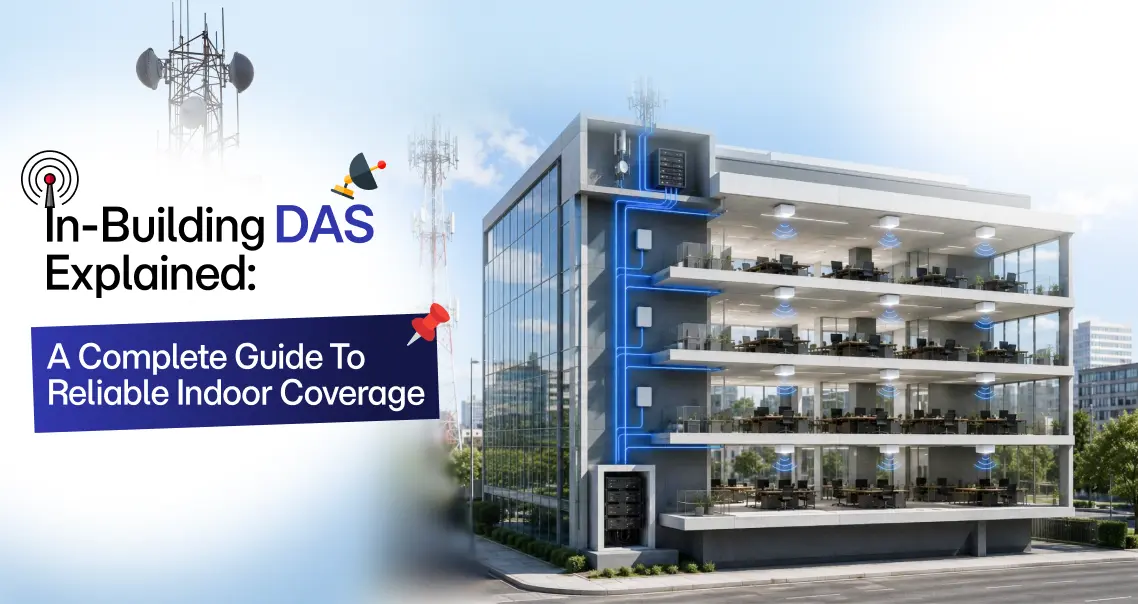
In-building DAS (Distributed Antenna Systems) is designed to boost wireless signal coverage inside buildings. DAS sends signals from a network of antennas that are placed throughout the building strategically to provide persistent and high-quality coverage.
The system is designed so as to avoid common connectivity disruptions such as weak signal strength, slow mobile data, and even dead zones. Say, if you are working in a high-rise building or staying at a hotel, no matter where you are, DAS ensures you experience an uninterrupted mobile or cellular connectivity.
It’s not like a signal booster that amplifies an existing weak signal; in-building DAS is engineered for high-capacity coverage across complex indoor spaces. It is capable of supporting single as well as multiple operators through a shared infrastructure.
Why Indoor Cellular Coverage Matters More Than Ever
When you walk into a beautifully designed modern building and watch the signal bar on your phone drop, it’s frustrating. If there’s a business running inside the facility, it is a massive operational failure.
Today, when IoT devices, cloud applications, and remote teams demand reliable mobile or cellular connectivity, relying on outdoor cell towers is no longer enough. The walls guarding your office appear as a barrier hindering communication.
Here’s exactly where the DAS system changes the game.
🔷 Hybrid Workplaces
The collaboration system, access management, and voice and video calling are all tied to a device that needs a signal to function.
🔷 Smart Buildings
Modern buildings are equipped with intelligent systems that manage energy consumption, lighting, security, and occupancy. These technologies depend on connectivity to function and exchange data properly.
🔷 Digital Transformation
Manual processes are getting replaced by digital workflows. Mobile applications, remote support, and real-time communication have become a part of everyday operations.
🔷 IoT Devices
IoT devices are a standard part of commercial facilities, including security cameras, asset-tracking systems, and connected equipment. With the growing number of connected devices, indoor cellular coverage ensures they communicate and support seamless building operations.
🔷 Cloud Applications
Teams need to collaborate, store data, and access tools, which can be done by cloud-based platforms. Inconsistent connectivity interrupts workflows and delays accessing critical information.
🔷 5G Adoption
Ever since 5G rolled out, expectations for faster speeds and advanced applications have grown. To fully benefit from these capabilities, businesses need indoor infrastructure that delivers reliable 5G coverage throughout every corner of the building.
🔷 High-Density Environments
Airports, shopping malls, stadiums, large office buildings, and so on have thousands of people using mobile networks simultaneously. Naturally, this demand strains traditional coverage and creates network congestion. Effective indoor coverage enables consistent connectivity.
Which Type of DAS Is Right for Your Building?
DAS is used to extend cellular network coverage throughout the building. The signal performance depends mainly on the type of technology that is employed, which extends the coverage throughout the area.
Let’s understand the different types of DAS, each fit for different deployment scenarios:
▶️ Passive DAS
These are used in small and mid-sized buildings and are comparatively easier to install and maintain. In passive DAS, the signal from the source is boosted by the head-end and distributed to the antenna nodes via coaxial cables and splitters. The systems are designed to enhance wireless networks by distributing signals across environments.
Passive DAS is best suited for spaces where coverage requirements are straightforward.
Examples: Hotels, schools, office spaces, and retail stores.
▶️ Active DAS
Active DAS systems are mostly used in large venues to distribute signals. It relies on multiple antennas deployed throughout the area, which increases the complexity of the system. With the help of fiber optic technologies, the transmission of RF signals can be enhanced. This type of DAS digitizes the signal, which increases the overall cost.
Active DAS delivers unmatched performance and supports multiple operators that is best for 5G and future network technologies.
Examples: Airports, stadiums, hospitals, large commercial buildings, corporate campuses, and convention centers.
▶️ Hybrid DAS
Hybrid DAS combines the components of both passive and active systems, balancing performance and cost-efficiency. It uses fiber optics for long-distance signal distribution while leveraging passive components in localized areas to extend coverage. This approach reduces infrastructure costs.
Hybrid DAS is best for organizations seeking flexible solutions that support future expansion.
Examples: Mixed-use commercial complexes, university campuses, large office parks, shopping malls, hotels, and multi-building healthcare campuses.
Core Components of a DAS for Reliable Indoor Mobile or Cellular Connectivity
An in-building DAS is made of several interconnected components that work together to deliver strong cellular coverage throughout the building. Every part plays a particular role in distributing and maintaining high-quality signals. This ensures the user experience remains uninterrupted whenever indoors.
⏭️ Signal Source
This is where the system picks up its original signal, either from a nearby cell tower or a small cell. The signal provides the cellular network that will be dispersed throughout the building. This ensures that every user remains connected to their preferred carrier.
⏭️ Head-End Equipment
The head-end takes the incoming signal and boosts it. In a Bi-Directional Amplifier (BDA) setup, it amplifies the signal in both directions, from the tower to the building and back out. In large active systems, this is instead a dedicated base station.
⏭️ Distribution Network
The signal distribution network carries the signal from the head-end to different parts of the building. Based on the DAS type, this network may use fiber-optic cables, coaxial cables, or a combination of both. The purpose is to transport the signal while minimizing signal loss.
⏭️ Remote Units
In Active and Hybrid DAS system, remote units receive signals from distribution network and convert into RF signals before sending them to the indoor antennas. These units maintain strong coverage over long distances and across large facilities.
⏭️ Indoor Antennas
Indoor antennas are the final connections between the DAS and user’s mobile devices. Strategically installed throughout the building, they distribute cellular signals uniformly across meeting rooms, corridors, offices, and other indoor areas. This ensures comprehensive coverage, eliminates dead zones, and provides consistent connectivity.
Why Indoor Signal Fails in Modern Buildings
Modern buildings are designed to improve energy efficiency and safety, but these features make it tough for signals to travel indoors. Here are some common reasons why mobile coverage weakens inside:
1️⃣ Building Materials
Materials utilized in modern constructions absorb cellular signals before they reach users.
- Thick concrete walls reduce signal strength
- Steel structures interfere with RF signals
- Low-emissivity glass reflect cellular signals not allowing them to pass through
- Reinforced walls and metal roofing create extra signal barriers
2️⃣ Large and Complex Building Layouts
Outdoor signals have a hard time providing consistent connectivity in a large, complex building.
- Several floors increase the distance a signal needs to travel
- Enclosed rooms or long corridors create uneven coverage
- Thick wall interior weakens signals between different areas
- Open spaces need a wider, reliable signal distribution
- Basements receive little to no coverage
3️⃣ Weak Outdoor Signal Penetration
Indoor coverage is affected by the strength of the signal outside the building.
- Buildings located far from cell towers receive weaker signals
- Nearby structures can block outdoor coverage
- Lower signal quality outside results in poor indoor connectivity
- Dense urban environments reduce signal penetration
4️⃣ High User Density
When several people connect to the same network at the same time, cellular performance can decline.
- Office buildings may have hundreds of employees using mobile devices
- Shopping malls experience heavy customer traffic
- Stadiums, events, and airports handle thousands of connections
- Increased network demand can lead to slow mobile data speeds
5️⃣ Network Interference
Various building systems and electronic equipment can impact the network.
- Metal infrastructure can scatter cellular signals
- Electrical equipment generates radio frequency
- Several wireless systems operating together can interfere
- Signal quality may vary based on nearby electronic devices
6️⃣ Growing Data Demand
Modern businesses leverage far more mobile data than ever, which places immense pressure on indoor networks.
- Employees depend on cloud-based business applications
- Video meetings require high-speed mobile and cellular connectivity
- IoT devices exchange data across the network continuously
- Mobile applications require reliable connectivity to ensure seamless real-time operations
Single-Operator DAS vs Multi-Operator (Neutral Host) DAS
When planning an in-building DAS, one of the biggest decisions is whether to deploy a single-operator DAS or a multi-operator DAS. Both improve indoor cellular coverage; they serve different business purposes.
| Feature | Single-Operator DAS | Multi-Operator (Neutral Host) DAS |
| Carrier Support | Supports only one telecom operator | Supports multiple telecom operators at the same time |
| User Experience | Requires a dedicated DAS for each operator if multiple networks need support | Single shared DAS infrastructure serves all participating operators |
| Infrastructure | Requires a dedicated DAS for each operator if multiple networks need support | Single shared DAS infrastructure serves all participating operators |
| Deployment Cost | Lower initial investment | Higher upfront investment, but offers better long-term cost efficiency |
| Maintenance | Easier to manage but may need additional systems as carrier needs grow | Simplifies long-term maintenance by managing one shared system |
| Scalability | Limited flexibility | Easily scales to support additional operators |
Key Features of a High-Performance In-Building DAS
Not every DAS delivers the same result. Some systems extend cellular coverage; a high-performance in-building DAS is designed for superior mobile or cellular connectivity and to adapt to future technologies. Selecting a solution with the right features means reliable indoor coverage today while safeguarding your investment for years to come.
⏭️ Multi-Operator Support
A high-performing system runs on multiple carriers on shared infrastructure since day one, it doesn’t require a redesign each time a new tenant needs a different network.
⏭️ Scalability for 5G and IoT
As 5G adoption increases, indoor connectivity infrastructure needs to be ready to support higher data speeds, greater network capacity, and lower latency. A future-ready DAS is designed to accommodate current cellular technologies while simplifying upgrades for emerging wireless standards.
⏭️ Uniform Signal Distribution
Whether it’s the basement or the elevator, coverage needs to be consistent across every zone, not just along the weak edges. Uneven coverage points to poor RF design and not a hardware issue.
⏭️ Scalable Architecture
Connectivity in business continues to evolve. A scalable DAS allows businesses to expand coverage, integrate new technologies, and accommodate more users without the need to eliminate or replace the whole infrastructure. This flexibility facilitates long-term business expansion.
⏭️ Seamless Integration
DAS integrates seamlessly with the current telecom infrastructure and building systems. This, in turn, reduces the complexity associated with deployment and allows normal operations to continue. All of this collectively ensures faster implementations and efficient performance of networks from day one.
⏭️ Continuous Monitoring and Optimization
Network performance shouldn’t end after installation. Advanced DAS solutions include continuous monitoring to detect signal quality, performance issues, and keep coverage consistent as network conditions and user demands change over time.
⏭️ High Capacity for Dense Environments
Large commercial buildings need to support hundreds or even thousands of users at the same time. DAS is designed to handle high user density without compromising call quality, data speed, and overall network reliability.
⏭️ Reliable Performance and Low Maintenance
A high-performing DAS provides uninterrupted connectivity, which requires minimal maintenance. Intelligent system design, high-quality components, and proactive support reduce downtime, lower operational costs, and maintain reliable performance throughout the lifecycle of the system.
Why In-Building DAS Is a Smart Investment
A well-designed DAS delivers value to everyone who uses the building, from property owners and facility managers to employees, tenants, and visitors.
- Better Voice Quality: Delayed audio or dropped calls can slow down business operations. In-building DAS delivers more stable signals that enhance voice clarity. Teams can enjoy clear and uninterrupted communication for productivity.
- Faster Mobile Data: Modern businesses depend on mobile devices for cloud applications, file sharing, and real-time collaboration. A DAS improves data performance with consistent signal strength, allowing users to stream and browse content without unnecessary delays.
- Elimination of Dead Zones: These are common in large buildings where there are underground spaces, steel structures, and thick walls. When antennas are placed strategically throughout the building, reliable coverage is possible in every corner with in-building DAS.
- Improved Employee Productivity: Employee productivity is improved when one doesn’t have to struggle with poor connectivity. Indoor coverage ensures quick collaboration across departments.
- Better Customer Experience: Visitors expect seamless connectivity whenever they are on your premises. Poor signals can cause negative experiences. An in-building DAS enables businesses to improve customer satisfaction and strengthen their brand reputation.
- Increased Property Value: When tenants and businesses are choosing commercial properties, reliable indoor mobile and cellular connectivity are important features. Well-equipped buildings with modern DAS stand out in competitive real estate due to better digital experiences. This attracts premium occupants and enhances property’s long-term market appeal.
- Enhanced Public Safety Communication: In emergency situations, good connectivity is highly critical for coordinating responses. In-building DAS strengthens cellular coverage throughout the facility, letting security teams and building management stay connected when every second matters.
- Future-Proof for 5G: Businesses are looking for infrastructure that can keep pace with the increasing demands and coming of new applications. Many DAS solutions are designed to support current networks while remaining ready for future upgrades.
- Supports IoT: Smart buildings rely on connected devices such as security systems, sensors, and access controls to work efficiently. DAS offers dependable connectivity that these devices need to communicate properly. This offers real-time monitoring, automation, and smart building management foundations.
- Lower Infrastructure Costs: A shared DAS infrastructure supports multiple carriers instead of deploying indoor networks for each mobile operator. This reduces duplication, simplifies maintenance, and lowers the cost of operations.
Industries That Benefit from In-Building DAS
Coverage needs appear to differ based on the activities inside the building and what suffers when the signals fail. Here are some industries that benefit most from in-building DAS solutions.
🔶 Commercial Offices
Today’s workplaces rely on seamless communication for video conferencing, collaboration, and cloud-based applications. In-building DAS gives employees reliable connectivity throughout the office, which reflects the productivity of the workspace.
🔶 Healthcare Facilities
Reliable cellular coverage is crucial for patients, healthcare professionals, and emergency responders. Hospitals are relying on connected medical devices, staff communication, and patient monitoring systems tied to cellular networks.
🔶 Hotels and Resorts
Guests expect strong mobile coverage throughout their stay. From conference halls to hotel rooms, restaurants, and recreational areas. In-building DAS supports guest experience by delivering voice and data connectivity across the property.
🔶 Shopping Malls and Retail Centers
Uninterrupted mobile or cellular connectivity is expected in shopping malls and retail centers to support inventory management, mobile payments, and other operations. DAS ensures retailers and shoppers enjoy consistent cellular coverage even during peak hours.
🔶 Airports and Transportation Hubs
Railway stations, airports, and transit terminals deal with innumerable passengers every day. Fortunately, DAS supports seamless communication for staff and passengers across a high-traffic environment.
🔶 Stadiums and Event Venues
Sports events, concerts, and exhibitions create massive network demand as there are thousands of attendees using their mobile devices. DAS provides the capacity needed to support social media sharing, live streaming, voice calls, and more without network congestion.
🔶 Industrial and Logistics Facilities
IoT sensors, real-time tracking, and inventory management are crucial to warehouses and distribution centers. Especially in metal-heavy structures, signal loss is most severe, making in-building DAS all the more essential.
🔶 Educational Institutions
Schools and university campuses deal with high device density with multi-building layouts, consisting of students, faculty, and connected classroom technology all competing for consistent coverage across very different structures.
🔶 Government and Public Safety Buildings
Government offices and public facilities require highly secure, reliable connectivity for employees, visitors, and emergency services. This makes DAS a necessity, ensuring day-to-day connectivity.
How In-Building DAS Deployment Works
Deploying an in-building DAS is a structured process that goes beyond simply installing antennas. It requires expertise and experience, for it involves careful planning, designing, and testing to deliver reliable indoor coverage.
Step 1: Site Assessment & Planning
- A detailed site survey is conducted to assess the building layout and construction materials.
- Spot coverage gaps, user density, and high-traffic areas that need reliable connectivity.
- Lay out project objectives, carrier requirements, and future scalability needs.
Step 2: RF Design & System Engineering
- Create an RF design for uniform indoor coverage.
- Study the ideal placement of cables, antennas, head-end equipment, and remote units.
- Minimize signal interference and ensure the design supports multiple operators.
Step 3: Installations, Integration, and Testing
- The approved design is brought to life with careful implementation.
- Install the DAS and connect it to the building’s existing mobile network and other systems.
- Perform end-to-end testing to verify signal strength and overall system performance.
Step 4: Monitoring, Optimization, and Ongoing Support
- The system’s performance is monitored continuously.
- Optimize coverage to accommodate changing user demands and new technologies.
- Provide ongoing technical support for long-term indoor connectivity.
How to Choose the Right In-Building DAS Provider
Even the best DAS can underperform if the design, installations, and ongoing support fall short. Selecting the right in-building DAS provider isn’t the final step, but it shapes every stage that came before in this guide.
NeutraCom is Egypt’s leading Neutral Host Platform, allowing seamless indoor mobile and cellular connectivity. Holding a National Telecom Regulatory Authority (NTRA) licensing, it keeps every operator connected, eliminating the operational chaos.
Here’s how NeutraCom makes a difference:
*️⃣ End-to-End DAS Expertise
Site surveys, RF planning, installation, testing, and so on, we provide complete DAS deployment service under one roof. This streamlined approach means every component works to deliver consistent indoor coverage.
*️⃣ Multi-Operator & Neutral Host Solutions
Our DAS solutions are designed to support multiple mobile network operators through a shared infrastructure. This delivers seamless connectivity for tenants, customers, and employees, regardless of their carriers.
*️⃣ Future-Ready Infrastructure
NeutraCom’s solutions are built with scalability in mind. Whether you are preparing for 5G expansion, increasing user capacity, or integrating IoT-enabled systems, we help ensure your network is ready for what’s next.
*️⃣ Customized for Every Building
Two buildings are never the same when it comes to connectivity. We carefully assess your building’s structure, functional needs, and occupancy to design DAS solutions that deliver optimal coverage without unnecessary complexity.
*️⃣ Reliable Performance & Ongoing Support
A system designed only for today’s needs will require expensive rework the moment tenants’ demand increases. We monitor, optimize, and maintain your DAS infrastructure for reliable connectivity and consistent performance.
Build a Stronger Foundation for Indoor Mobile or Cellular Connectivity
If your building is still struggling with dropped calls or indoor dead zones, it’s probably not your mobile network but your building. As workplaces become smarter, relying solely on mobile connectivity is no longer an option.
An in-building DAS Solution solves this by providing seamless connectivity. And with the right deployment partner, you get a solution that’s built to perform today and scale for tomorrow.
Looking to improve your indoor connectivity? NeutraCom helps you design and deploy an in-building DAS that’s tailored to your building needs.
Frequently Asked Questions
The timeline for deploying in-building DAS varies based on the infrastructure, complexity, and building size. A small building may take a few weeks, while large facilities such as hospitals and airports can take several months.
Yes, a multi-operator (Neutral Host) DAS is specially designed to support multiple cellular carriers through a single shared infrastructure. This means tenants, employees, visitors, and customers enjoy reliable coverage. By comparison, single-operator DAS supports only one carrier and is best suited to buildings where a single network meets all connectivity needs.
Yes. A properly designed DAS strengthens indoor cellular coverage, helping emergency responders and building occupants maintain reliable communication during critical circumstances.
Yes, requirements vary by jurisdiction and involve coordinating with local authorities and telecom regulators, particularly for neutral host systems that support multiple carriers. A qualified provider manages this process as part of the deployment rather than leaving it to the building owner.
No, there’s no strict cutoff, but DAS becomes cost-effective once a building has multiple floors, persistent coverage complaints, and dense occupancy that can’t be fixed by a booster. Smaller single-tenant spaces find passive DAS or other solutions more proportionate to their needs.
New carriers can be integrated into an existing neutral host system without replacing the entire infrastructure. Once onboarded, they are connected, tested, and optimized, allowing the system to expand with minimal disruption and downtime.
Not always; many modern DAS systems can be upgraded to support 5G by enhancing existing infrastructure, reducing the need for a complete replacement, and minimizing costs and disruptions.