
Key Takeaways:
- Indoor mobile coverage challenges occur due to urban buildings being designed with materials that obstruct radio frequencies.
- Important activities such as video conferencing, emergency communication, smart building systems, cloud apps, etc., depend on indoor coverage.
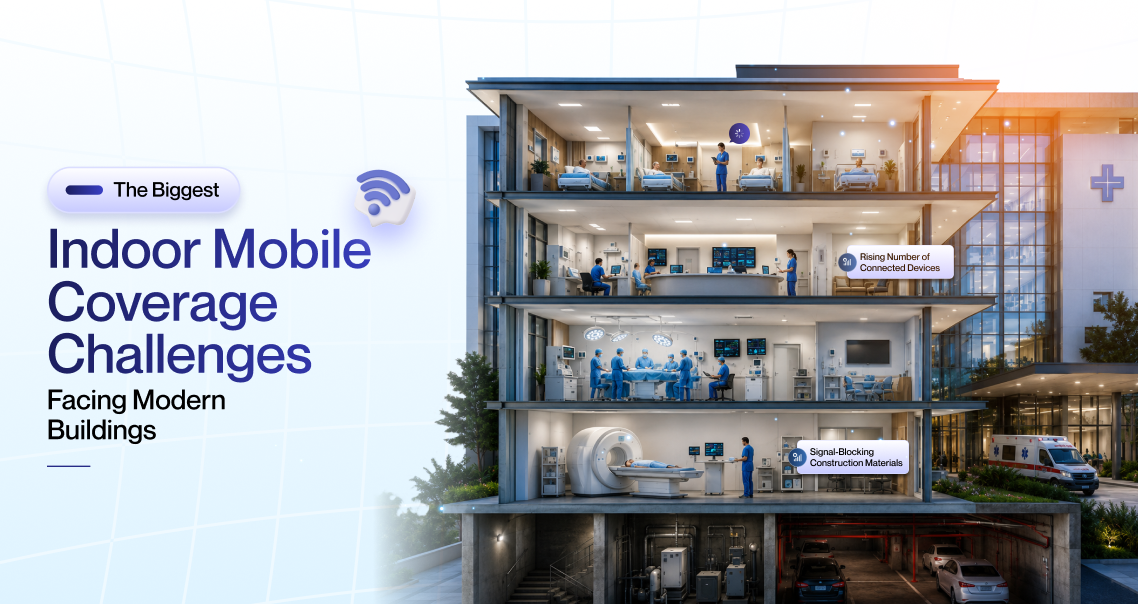
- Some of the biggest mobile coverage challenges are signal-blocking materials, complex indoor layouts, a rising number of connected devices, and legacy infrastructure.
- Indoor coverage solutions include DAS, NHI, Private LTE, and RF Planning.
Why Indoor Connectivity Is Becoming Harder to Ignore
You think the mobile coverage gap is a rural problem?
Actually, the biggest mobile coverage challenge is in modern buildings. Malls, hospitals, or public-sector buildings record the highest usage of cellular devices. Studies show that most data usage and phone calls occur indoors.
Indoor mobile coverage challenges arise due to the materials used in urban structures, which are designed for energy-efficiency but obstructs radio frequencies. This is what makes it important for network planners to understand. Advanced in-building DAS solutions for modern buildings allow individuals to expect seamless connectivity.
As businesses rely on uninterrupted connectivity today, indoor coverage is operationally important.
Why Indoor Connectivity Matters More Than Ever
Reliable mobile signals are a cornerstone of effective communication for modern businesses. Individuals face indoor mobile coverage challenges due to poor signal strength despite excellent reception outside.
🔷 Video Conferencing
Problem: Hybrid workplaces expect uninterrupted video conferences and real-time collaboration indoors.
Impact: Understandably, weak signals can lead to poor communication experience, call drops, and reduced productivity.
🔷 Emergency & Public Safety Communications
Problem: Hospitals, industrial facilities, or airports depend on uninterrupted communication during emergency situations. Fire safety systems and emergency communications are highly dependent on in-building wireless infrastructure.
Impact: An indoor coverage issue in critical situations can lead to serious consequences, affecting the response time.
🔷 IoT & Smart Building Systems
Problem: Modern businesses depend on connected IoT devices, smart infrastructure, and automation systems that demand stable wireless connectivity.
Impact: Poor indoor coverage disrupts the system’s performance and leads to delays in business workflow.
🔷 Cloud Applications
Problem: Cloud apps are one of the important business tools used for communication, sharing files, and more.
Impact: Unstable indoor signals can lead to interrupted access, create delays in accessing critical files, and workflow can come to a halt at the worst possible moment.
🔷 Increasing Number of Connected Devices
Problem: Modern buildings deal with the presence of large numbers of smartphones, wearables, and connected systems.
Impact: Increasing number of device connections creates network congestion and often leads to indoor connectivity inconsistencies.
🔷 Tenant & User Experience
Problem: People expect seamless mobile connectivity inside a building, especially in parking areas, elevators, and crowded indoor zones.
Impact: Poor indoor coverage affects customer satisfaction.
The Biggest Indoor Mobile Coverage Challenges in Modern Buildings
So far, it’s been established that modern buildings do create indoor mobile coverage challenges, with approximately 80% of mobile usage occurring indoors.
Weak indoor connectivity doesn’t happen due to a single reason. Paradoxically, modern structures that shape the building act as a barrier to RF signals.
Here are some of the major problems seen in modern environments today.
➡️ Signal-Blocking Construction Materials
Contemporary buildings are designed keeping energy efficiency in mind, but due to certain materials, the signal strength becomes quite weak.
Certain materials, such as metal, concrete, and energy-efficient windows, block frequencies, creating weak spots, or even dead zones. All of it impacts productivity in the end.
On the other hand, steel structures are highly durable, but they limit wireless signals, reducing the capability of Wi-Fi to travel through walls and floors.
➡️ Complex Indoor Layouts and Design
Indoor mobile coverage challenges in modern buildings are caused by energy-efficient materials used in construction and complex floor plans. These buildings are unintentionally radio-tight spaces that lead to internal obstructions and network congestion.
Large buildings usually have multiple floors, underground space, and enclosed rooms with dense interiors. In places like office towers, malls, hospitals, airports, stadiums, and more, cellular coverage struggles to stay consistent across every area.
➡️ Rising Number of Connected Devices
The increasing number of connected devices in buildings right now leads to a massive indoor coverage problem. Modern structures are built with energy-efficient materials, and connected devices such as surveillance cameras, smart lighting, tablets, laptops, automation platforms, and more create connectivity pressure and lead to poor performance.
Modern networks like 5G do offer immense data capacity; however, they struggle to travel through walls or other physical obstacles.
➡️ Legacy Infrastructure
Many buildings still depend on an outdated telecom system that was not designed to support today’s high device density. Older networks struggle with modern connectivity demand.
In many cases, these buildings were not originally designed to support technologies like 4G, 5G, and IoT-enabled systems. As a result, maintaining consistent indoor coverage across all areas becomes more challenging.
Enhancing indoor mobile coverage in high-density buildings is more than essential today.
Identifying Coverage Gaps in Complex Indoor Environments
Recognizing indoor coverage issues and providing solutions for modern buildings is important across multiple sectors. The shadow zones disrupt productivity, affecting daily operations.
Here are specific industries that face distinct types of gaps.
▶️ Hospitals & Healthcare Facilities
Connected systems are an important part of healthcare facilities for service delivery and patient satisfaction. Doctors depend on their phones to coordinate with patients.
Unfortunately, the construction materials, multiple floors, and specialized medical equipment can interfere with indoor signal distribution across departments. Reliable connectivity for emergency communication and connected medical systems are highly critical for patient experience and safety.
▶️ Shopping Malls & Retail Spaces
Shopping malls and modern retail stores rely on connectivity. Dense building materials and multi-floor layouts block cellular signals that lead to slow/failed online transactions, delays in stocking and inventory operations, reduced customer engagement, and reduced access to emergency services.
Increased mobile internet consumption and high visitor density during peak hours put additional pressure on indoor networks.
▶️ Airports & Transportation Hubs
Airside and terminals at the airport have weakened signal due to the gradual expansion leading to complex layouts and large structures. Both passengers and staff expect reliable connectivity across every stage of the travel journey.
Transportation hubs such as metros, tunnels, etc., experience constant foot traffic. This makes underground spaces and enclosed areas experience major indoor mobile coverage challenges.
▶️ Commercial Offices & High-Rise Buildings
Poor signal issues in commercial offices and high-rise buildings are caused by e-glass, concrete, and other energy-efficient materials. Areas like elevators, meeting rooms, and parking lots are especially affected.
This becomes a huge problem in modern workplaces where employees rely on cloud apps, video calls, and more throughout the day.
▶️ Hotels & Hospitality
Guests live through their smart devices, which makes high-quality mobile coverage a critical component of hotel performance. Poor indoor coverage frustrates guests and may impact brand perception as well.
Large property layouts and various indoor sections make indoor coverage difficult to maintain.
▶️ Industrial & Logistics Facilities
Indoor cellular coverage troubles in industrial and logistics facilities lead to operational bottlenecks. Building materials and complex indoor layouts can create dead zones that disrupt critical operations such as warehouse operations, asset tracking, and real-time communication.
Industrial operations depend on IoT devices, connected systems, and real-time monitoring platforms. With digital operations expanding, the demand for indoor wireless connectivity continues to grow.
Why Traditional Indoor Coverage Methods Fall Short
With a lack of planning, the network may only create coverage gaps and result in inefficiency. Network planning requires analyzing coverage requirements and knowing the actual placement of network components.
If you are still thinking traditional approaches for network coverage are the way to go, you are only giving rise to more bottlenecks.
⏭️ Built for Older Connectivity Needs
- Traditional indoor coverage systems were created to support fewer users and lower mobile data usage.
- Modern spaces rely on cloud platforms and constant connectivity that older systems won’t be able to cope with.
⏭️ Limited Coverage in Large Buildings
- Basic signal boosters struggle with consistent coverage across large indoor spaces.
- More intricate and complex layout areas encounter poor signal strength.
⏭️ Challenges Supporting 5G Connectivity
- Higher-frequency signals have lower indoor penetration compared to older network technology.
- Traditional indoor coverage systems aren’t optimized to support 5G infrastructure requirements.
⏭️ Lack of Multi-Operator Support
- Various traditional setups are created around single-operator infrastructure, limiting flexibility.
- This can lead to an inconsistent user experience depending on the mobile operator being leveraged inside.
⏭️ Scalability Limitations
- Expanding traditional network systems indoors can be difficult, as modern buildings are more flexible in adapting to connected technologies.
- Upgrading legacy systems increases deployment issues and increases cost over time.
Indoor Coverage Solutions for Modern Buildings: The NeutraCom Advantage
As the indoor mobile usage grows, infrastructure planners and businesses are searching for more future-ready indoor cellular coverage solutions.
Instead of relying on outdated and fragmented systems, it’s best to adopt high-performing infrastructure that can support multiple operators and connectivity demands.
NeutraCom is a leading neutral host operator in Egypt, helping modern buildings with indoor wireless connectivity through shared infrastructure and scalable network design that fits today’s digital environment.
🔶 Distributed Antenna Systems (DAS)
Indoor wireless connectivity is a necessity for modern buildings. Distributed Antenna Systems is a groundbreaking technology that expands wireless connectivity into challenging buildings, ensuring robust connections. DAS is common in high-rise buildings, hospitals, airports, stadiums, malls, and large venues where outdoor signals struggle to reach indoor areas.
NeutraCom Advantage:
We deliver end-to-end DAS design, deployment, operation and maintenance – owning the cycle.
🔶 Neutral Host Infrastructure
Neutral host infrastructure for indoor coverage uses a single shared network instead of deploying different networks inside the same building. This minimizes infrastructure duplication and improves coverage consistency.
NeutraCom Advantage:
Our neutral host model creates a seamless shared connectivity infrastructure that simplifies deployment and supports multiple operators through one carrier-grade system.
🔶 Private LTE and Smart Building Integration
A Private LTE network supports strong and reliable connectivity for industrial operations, smart buildings, and connected IoT environments. These networks help modern buildings maintain steady communication across different levels of operations.
NeutraCom Advantage:
We support smart building connectivity through Private LTE integration. This allows businesses to manage connected systems and indoor wireless communication.
🔶 RF Planning and Optimization
Accurate RF engineering paves the way for effective indoor coverage solutions for modern buildings. Proper RF design identifies weak coverage areas and improves indoor coverage
NeutraCom Advantage:
Our experts provide RF planning and optimization services such as coverage analysis, signal testing, and network performance monitoring to improve reliable indoor coverage across complex spaces.
Build Reliable Indoor Connectivity for the Future
Indoor mobile coverage challenges are becoming more common with buildings getting smarter, more complex, and digitally connected.
Cellular connectivity is treated as an important part of the infrastructure as usage of mobile phones and other smart devices continues to grow exponentially. This makes indoor coverage solutions for modern buildings essential—for everything, from tenant satisfaction to emergency response.
Fixing the limitations requires a team of experienced professionals. NeutraCom offers neutral host platforms that allow digital transformation. Our indoor cellular coverage solutions for airports, malls, and stadiums, and other higher-density spaces, keep up with growing connectivity demands and expectations.
We strive to create connected modern buildings, connected industries, and smarter environments.
Frequently Asked Questions
To choose an indoor coverage provider, businesses should evaluate whether the provider can support multi-operator environments, 5G-readiness, RF expertise, and future scalability. Experience across diverse industries such as airports, commercial buildings, and malls plays a major role in successful deployment. NeutraCom offers comprehensive indoor coverage solutions for secure indoor connectivity.
Yes, we work closely with developers and infrastructure planners to integrate indoor wireless solutions into modern buildings. Integrating indoor coverage infrastructure during the construction phase is an efficient approach that aligns with the design and future connectivity needs.
Professional indoor coverage solutions are deployed according to telecom standards and safety regulations. Compliance plays an important role in different environments. Our experts follow industry-standard deployment practices with operators and infrastructure teams for seamless indoor connectivity solutions.